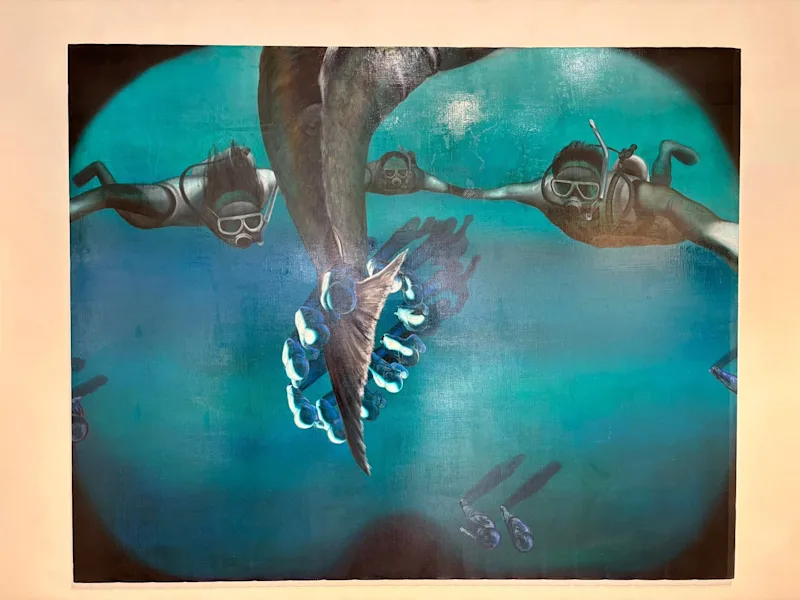
Where Tazaki's earlier work Endless Circle (2024) implicates the viewer structurally—through a goggle-shaped frame that absorbs the standing body into the composition—reunion operates from within: through a moment of misreading, and its correction.
Reunion is, in one sense, an ordinary word. It describes a meeting after separation yesterday, or after decades. The time span it contains ranges from days to years. In Tazaki Ari's painting of the same name, the subject of this reunion is never shown. A single figure appears in the composition, face cut from view. What fills the space instead are empty baby strollers, positioned throughout the scene, each accompanied by a coffee cup or glass placed in front of it.
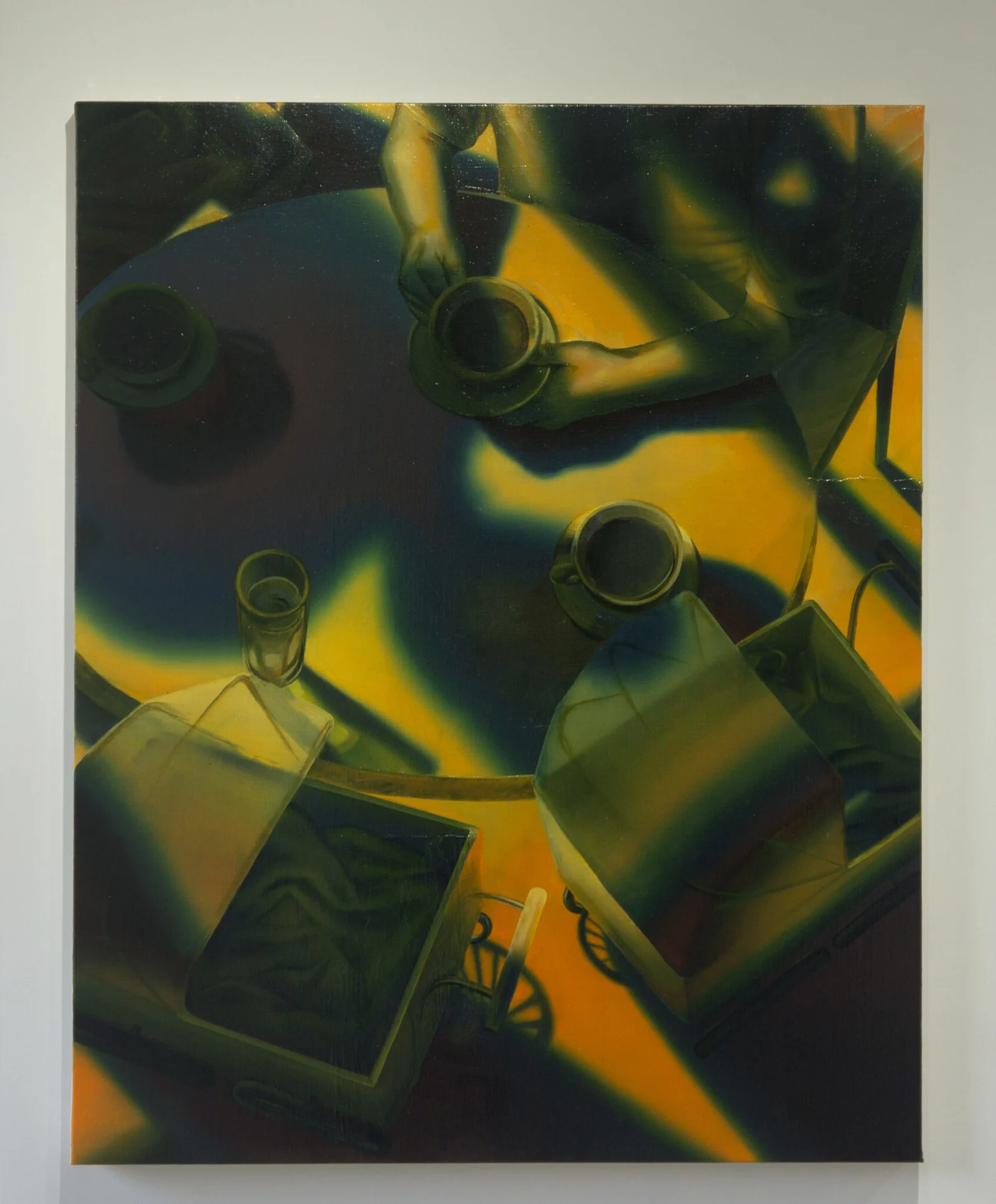
The strollers function as substitutes for absent people. The arrangement is deliberate. In the lower portion of the composition, a stroller is clearly identifiable as such. But in the upper left, only the edge of a boxy form emerges from the shadow; the rest sinks into the dark. It reads at first as the presence of a person—what the shadow conceals is an empty stroller. Tazaki has positioned the legible stroller below precisely to guide the viewer toward this correction, staging the misreading and its resolution in sequence.
What occurs in that moment of correction is the painting's central event. The viewer who realizes that what seemed to be a person is actually an empty vessel becomes suddenly aware of the act of looking itself—aware, specifically, that they are looking at a painting, that they have been constructing meaning from marks and shadows on a surface. The work does not merely depict absence. It produces a moment in which the viewer becomes conscious of their own perceptual activity.
Tazaki's handling of light extends this logic. The coffee cup in the upper left sinks into shadow while projecting a stronger presence than the cups more directly lit. Shadow does not diminish—it concentrates. This reversal, shadow as presence rather than absence, holds within it the same structure as the stroller: what appears to recede turns out to insist.
Reunion is a painting about what is not there. It is also a painting that makes the viewer briefly aware of what it means to look.