Endless Circle is a large-scale oil painting, 1303 × 1620 mm, hung on the wall directly facing the entrance of the exhibition space. The first impression is darkness. Sustained looking begins to resolve the composition: divers approaching from depth, hands linked; a fish's tail identifying the scene as underwater; human figures forming a ring around the tail, echoing the children's game kagome kagome—or grasping it. At the upper edge, a raptor's talons appear, having just secured prey.
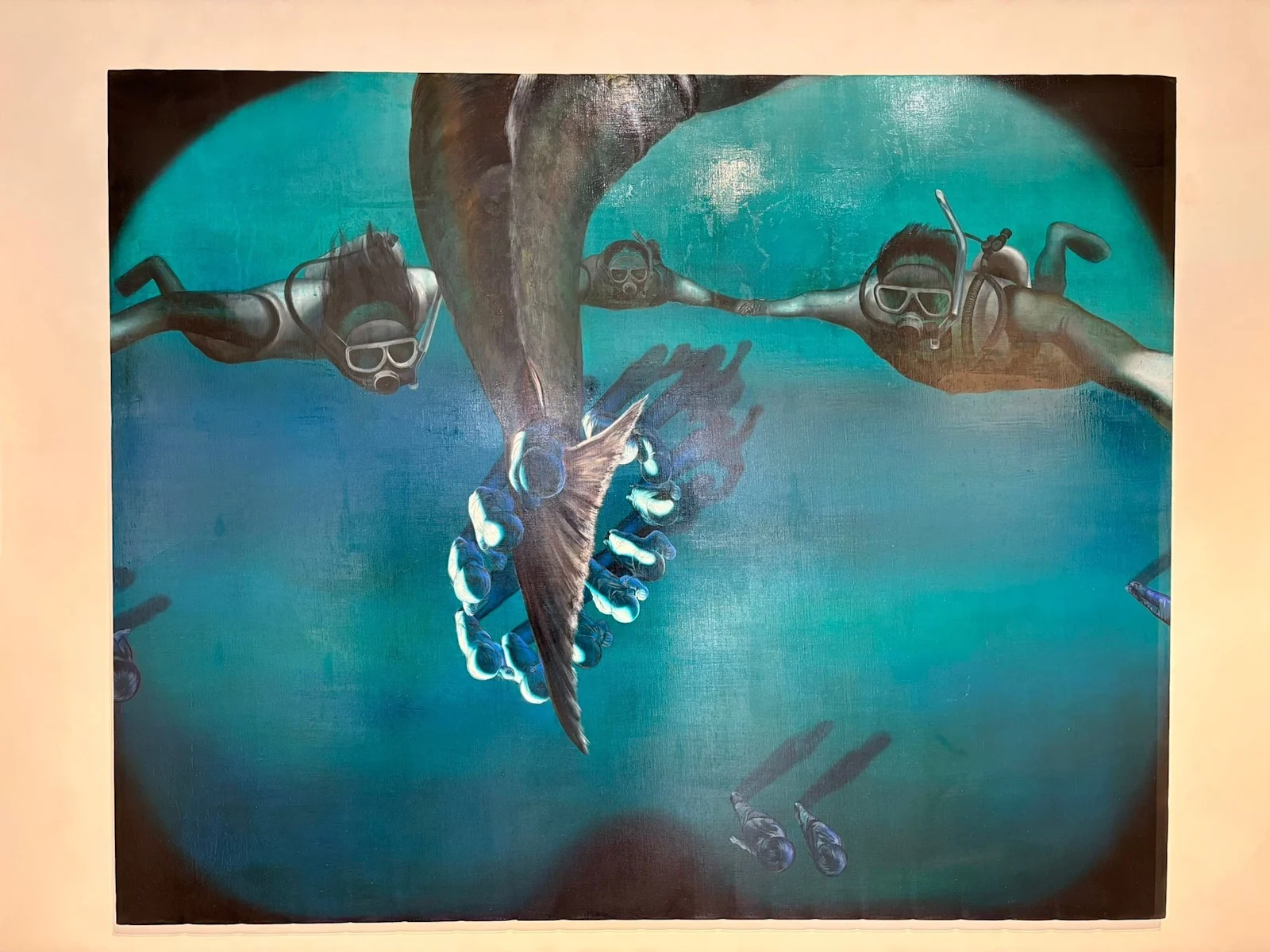
The human ring is doubled and tripled through shadows, generating multiple overlapping circles around the fish. The shadows imply an overhead perspective, collapsing the spatial orientation of the underwater scene. Up and down become indistinguishable.
The frame surrounding the entire composition takes the shape of diving goggles. This detail reorganizes the entire viewing experience. The viewer is not looking at a scene from outside—the viewer is already inside it, looking through the goggles, positioned among the divers in the distance. The ring that encircles the fish extends beyond the canvas edge, out into the space where the viewer stands. The circle is not complete within the picture plane. It requires the viewer to close it.
This is the work's critical proposition. The food chain depicted—raptor, fish, human infrastructure that kills the raptor—does not position any participant as innocent observer. The painting acknowledges that Tazaki, in making the work, participates in the same chain. The viewer, in looking, participates too. The goggles do not offer distance. They confirm immersion.
What Endless Circle constructs is not moral judgment but structural clarity: the chain of influence extends endlessly, and the act of observation does not place one outside it.