Takahashi Misaki has consistently worked with objects that have lost their original function: skeleton models, skulls, preserved specimens, industrial materials. Her realist technique is highly refined, but reproduction is not the point. What her paintings construct is a situation—a specific condition of presence in which the act of looking becomes the subject.
The graduation exhibition was installed in a small, room. A portfolio was placed outside, separating concentrated viewing from contextual reference. The spatial logic mirrored the paintings themselves: a deliberate control of distance between the viewer and what is depicted.
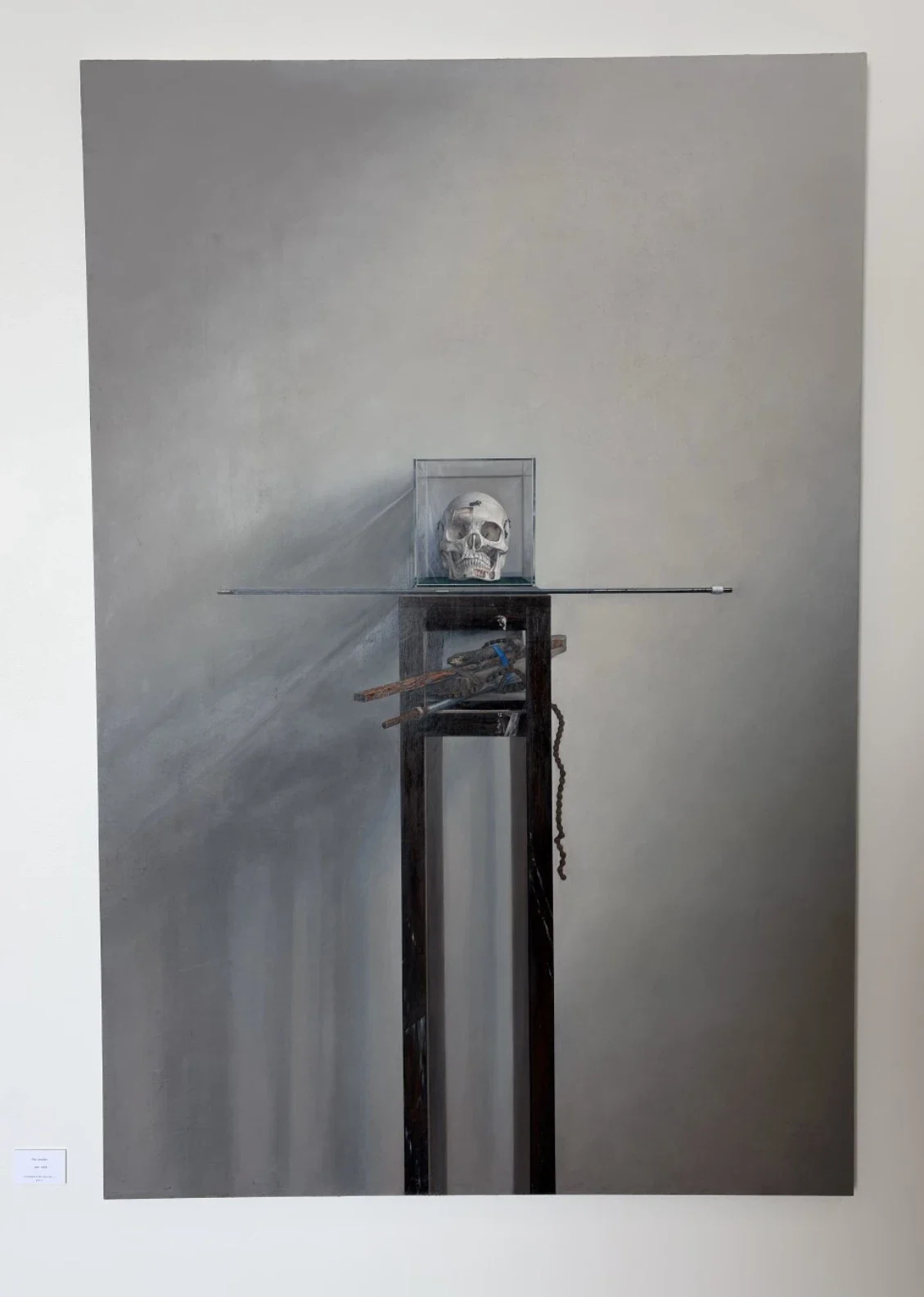
In Pale chamber, a skull sits enclosed in a glass case, aligned with a horizontal metal rod on a wooden stand. Below, a shelf holds a bundle of long objects—threaded rods, metal pipes, wood, a bicycle chain. The composition is restrained, the surrounding space generous. Yet the painting resists being read as a depiction of objects. What is rendered is not only the motifs but the circulation of light, the texture of the wall, the density of the surrounding air. The gray background is not uniform; faint variations in tone suggest a surface that absorbs and reflects unevenly. Standing before the work, the viewer does not feel that they are looking at an image. They feel as though they have arrived somewhere that already exists.
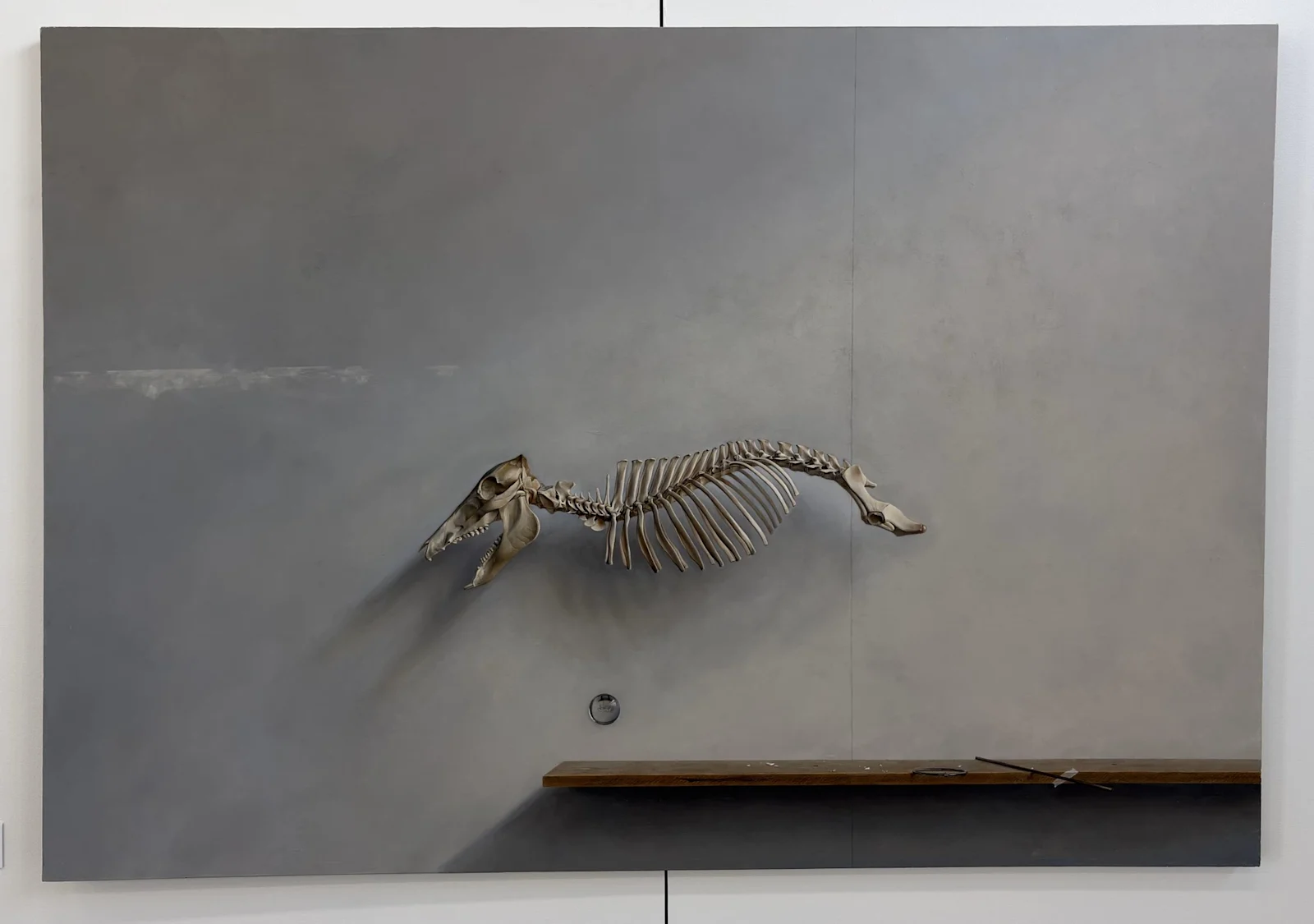
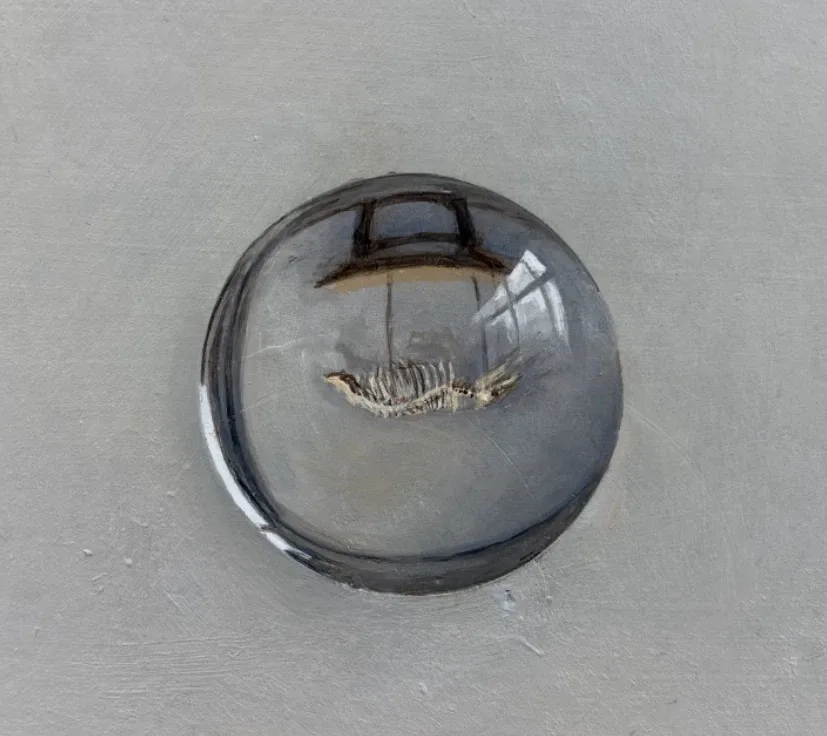
Still… extends this logic. A skeleton model appears suspended in midair, its supporting structure largely erased. In one area of the canvas, a small spherical reflective surface is depicted. Within that reflection, an inverted image of the scene appears—including the stand that supports the skeleton, the element absent from the main view. Support is simultaneously removed and preserved: denied as structure, retained as reflection. The act of faithful depiction, it turns out, does not simply show what is visible. It also points toward what is withheld.
These works prepare the ground for what Takahashi presented at the Gobidaiten—the joint exhibition of Tokyo's five major art universities—where a single work was shown. That selection was itself a declaration.
Still life depicts a body laid on a white cloth-covered surface. It is painted as a still life. Yet the skin holds color. The muscles carry tension. The question of whether the figure is living or dead does not resolve at the canvas edge—it persists in the viewer's body as an unsteady oscillation between two modes of looking: the gaze directed at a person, and the gaze directed at a thing. Takahashi does not dramatize this instability. She allows it to sustain, quietly, without resolution.
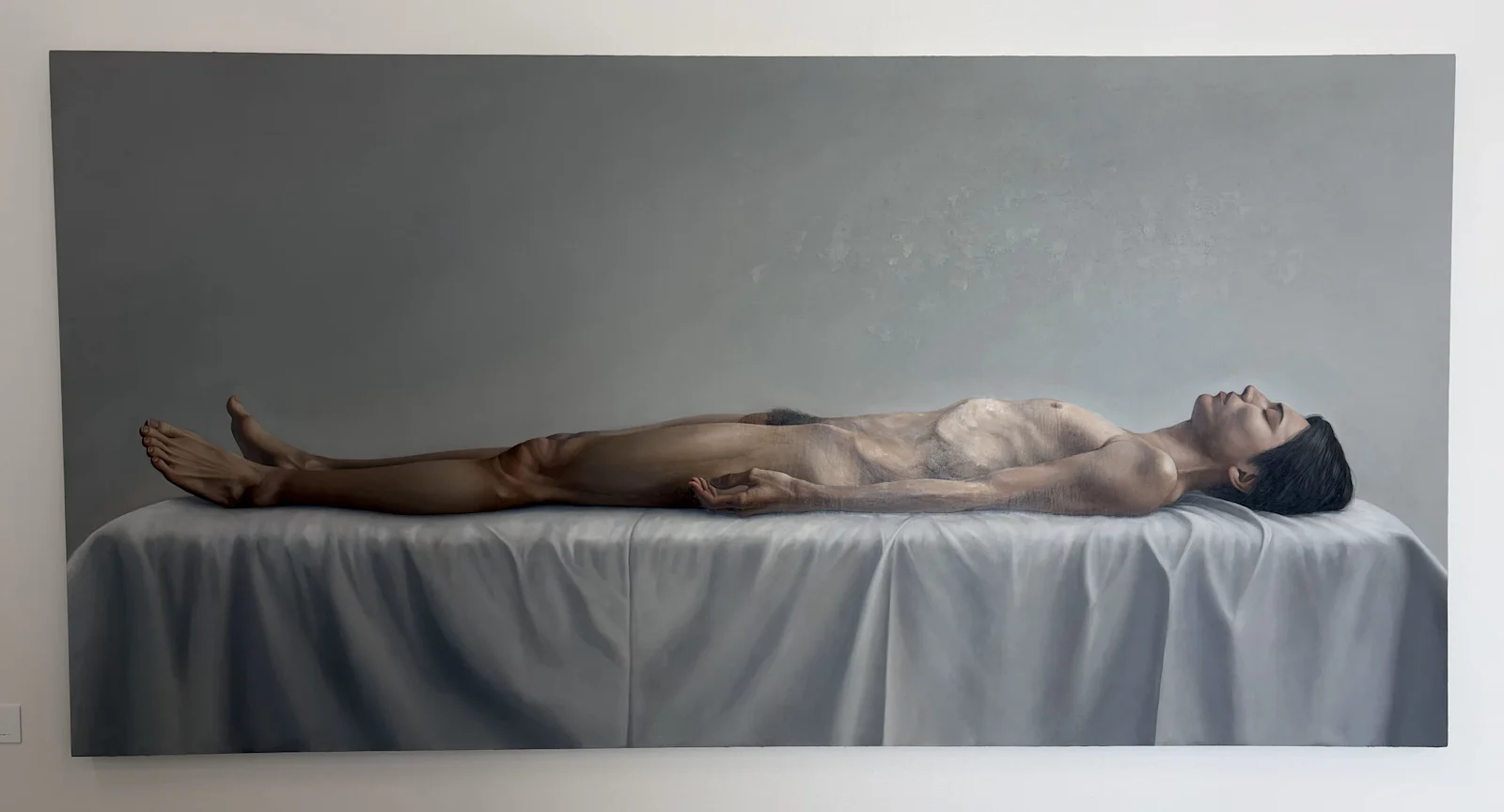
This is the culmination of what Takahashi's practice has been building: not a rethinking of still life as genre, but an exposure of the assumptions that organize how we look—at objects, at bodies, at the distance we maintain between ourselves and what we see.