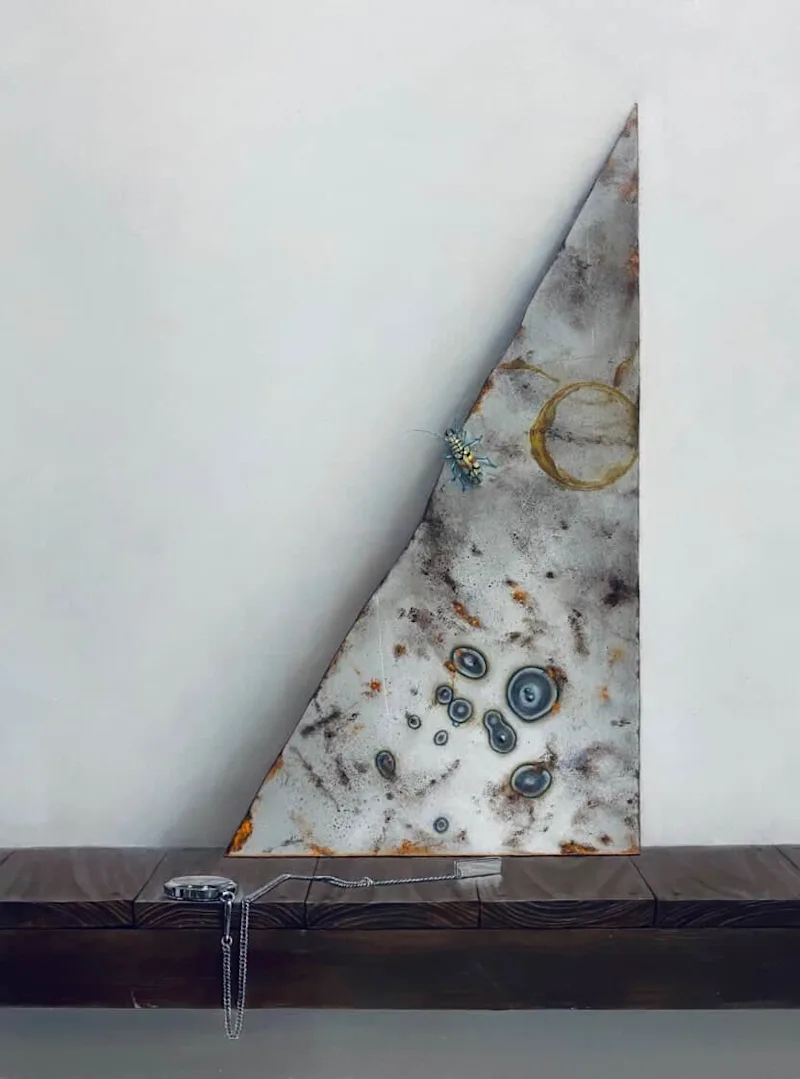
To paint is not to transcribe what is visible. It is to construct, from the ground up, the conditions under which a subject can exist within the picture plane.
This attention extends to every point in the background. The texture of a wall, the circulation of light, the density of the air surrounding the subject, these are not atmosphere. They are the conditions that allow the subject to be there. Everything depicted is held within the same necessity.
Objects that have fulfilled their purpose have already ceased to be something. They continue, quietly, as presence alone. This is why the work turns towards what is broken, what is incomplete. When function falls away, structure emerges more purely, and what remains appears weightless.
In the process of tracing a motif, I mistake proximity for familiarity. Yet the closer I come, the more the object's own time—a time I cannot know—asserts itself, and the subject recedes.
The marks and fractures of a motif removed from its original place are understood as loss of role or function. More often than not, this is a judgment imposed from outside. Without knowing what something once was, one cannot determine where it is broken. The days that continue within this ambiguity and silence carry a certain emptiness, yet they are entirely ordinary.
My painting stands on the premise of seeing.