Over the past four years, aaploit has shown artists with almost nothing in common at the level of medium. Their materials, techniques, and subjects do not overlap. Something runs through the practices all the same, and I only noticed it in hindsight.
Two inherited metaphors for what an artist does are involved. The first is Akimoto Yuji's "canary in the coal mine," from his 2019 book Art Thinking: the artist as an early-warning system, registering change before anyone else. It is an apt metaphor and still a persuasive one. What it assumes is an artist who is ahead: acute, prescient, at times heroic. It belongs to a long-shared belief that a gifted individual could define an era and carry a generation forward. The air around that belief does seem to have shifted over the past several years. No single figure comes into focus for the 2020s with the clarity earlier decades had. The isolation of the pandemic years was a stretch of time in which everyone converged on the same restricted present, and whatever romance had attached to the idea of diverging futures went quiet somewhere in there.
A second, less heroic metaphor fits better now: litmus paper. It does not forecast. It changes only on contact. What it registers is not a prediction of the world but the residue of contact. Even this metaphor carries a limit borrowed from chemistry that it cannot quite honor. A chemical threshold is fixed, but in art both what counts as a reaction and what a work reacts to keep shifting historically. Industrial materials and minimalism in the 1960s, and conceptual art, which moved the work from the object to the proposition; relational and participatory practices in the 1990s; AI now, alongside a return to craft and embodiment. Contemporary art does not only register the present. It keeps rewriting the instrument used to measure it.
The obvious next question is who does the rewriting, and the honest answer will not settle on a single subject. An auction record looks like the market setting the threshold, until you notice it usually arrives after the shift it claims to announce. Prices ratify what has already changed in the studio, dressed up as prophecy. Museums fare no better: acquisition and the slow labor of the canon increasingly read like an institution catching up to a threshold that moved without asking permission. That leaves the curator, and claiming the job would be flattering, but the claim does not survive contact with how these three practices actually came into view. I did not identify the pattern first and then go looking for Kumagae, Asano, and Michimata to illustrate it. The pattern appeared afterward, once I had read the three practices through their exhibitions. If there is a curatorial function here, it is not fixing the threshold but noticing, after the fact, that a number of works had already been reacting to the same submerged condition before the condition had a name. The curator is not the author of the threshold, only another kind of instrument, slower than the artist's, reading reactions that have already occurred.
If neither the market, the museum, nor the curator fixes the threshold in advance, artists are left in something close to what Camus called the absurd: the unresolved gap between the need for meaning and the world's silence on the matter. The three practices below describe that condition more precisely than I can here. His answer, in The Myth of Sisyphus and The Rebel, was neither self-erasure nor the philosophical leap into an ideology that manufactures a meaning the world never supplied, but révolte: lucid, sustained confrontation without the promise of resolution. Sisyphus is not redeemed by escaping his task. He is dignified by refusing to look away from it while continuing to push.
The three practices this essay revisits carry that out as method. None of them proposes to overturn the system it works within, and none offers moral resolution. Each stays inside a given structure and works it so faithfully that the structure's own violence surfaces without a word of accusation.
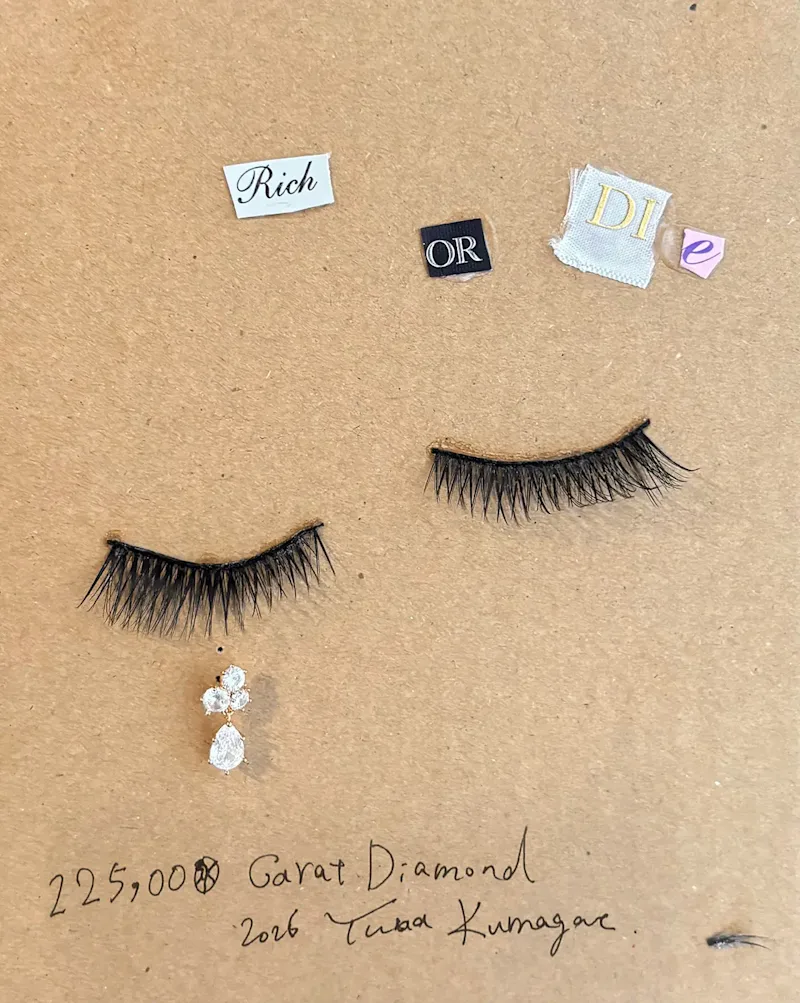
In 225,000 Carat Diamond (aaploit, January 2026), Kumagae Yuna converted her own body weight into carats, the unit in which diamonds are weighed and therefore the unit in which their price is calculated. She takes it faithfully, excessively, at its word, rather than denouncing it from outside, and the excess is entirely a matter of applying it correctly. The same operation runs through the objects. Kumagae paints on what she has finished using or been handed: cigarette packets, a colored-contact-lens box, cardboard. Those surfaces carry brand logos, the shine of jewelry, female figures, skulls, crosses. One is two hand sized artwork of cardboard, fabric and false eyelashes. Nothing is elevated here, in the sense of being redeemed by having been painted on. The discarded support and the luxury sign are held in the same measure, at a scale small enough that a viewer has to come close to see either one. The resulting oscillation is small, but more honest than not oscillating at all.
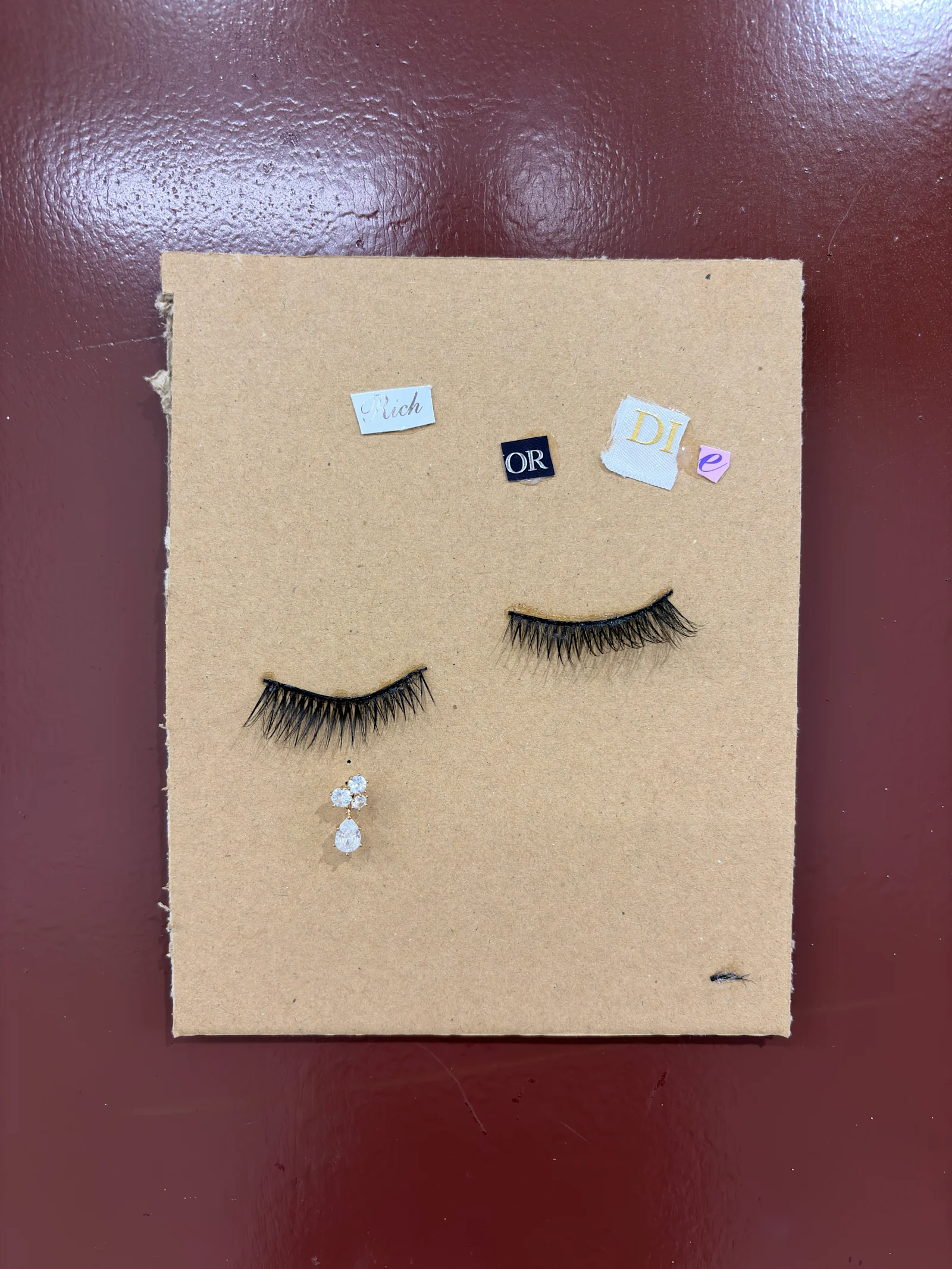
KUMAGAE Yuna, Untitled, 2025, Cardboard, earrings, collaged labels, and false eyelashes, 160 × 130 mm, ©2025 KUMAGAE Yuna, Courtesy of the Artist and aaploit
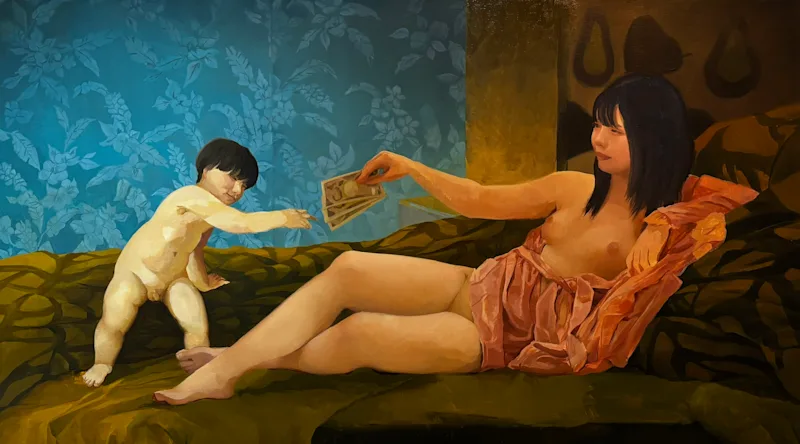
In Asymmetric Gaze (group exhibition, October 2025), Asano Miyabi painted in the manner of Palma il Vecchio and put, in place of Cupid's arrow, the ten-thousand-yen notes handed to a host club's tantō. The point is the reversal of direction. The arrow is fired from outside; desire has been pictured as something that arrives, passively received. Here the movement runs the other way. Desire is offered up and paid for. What surfaces is the transaction that Renaissance mythological rhetoric had always kept concealed inside its own imagery.
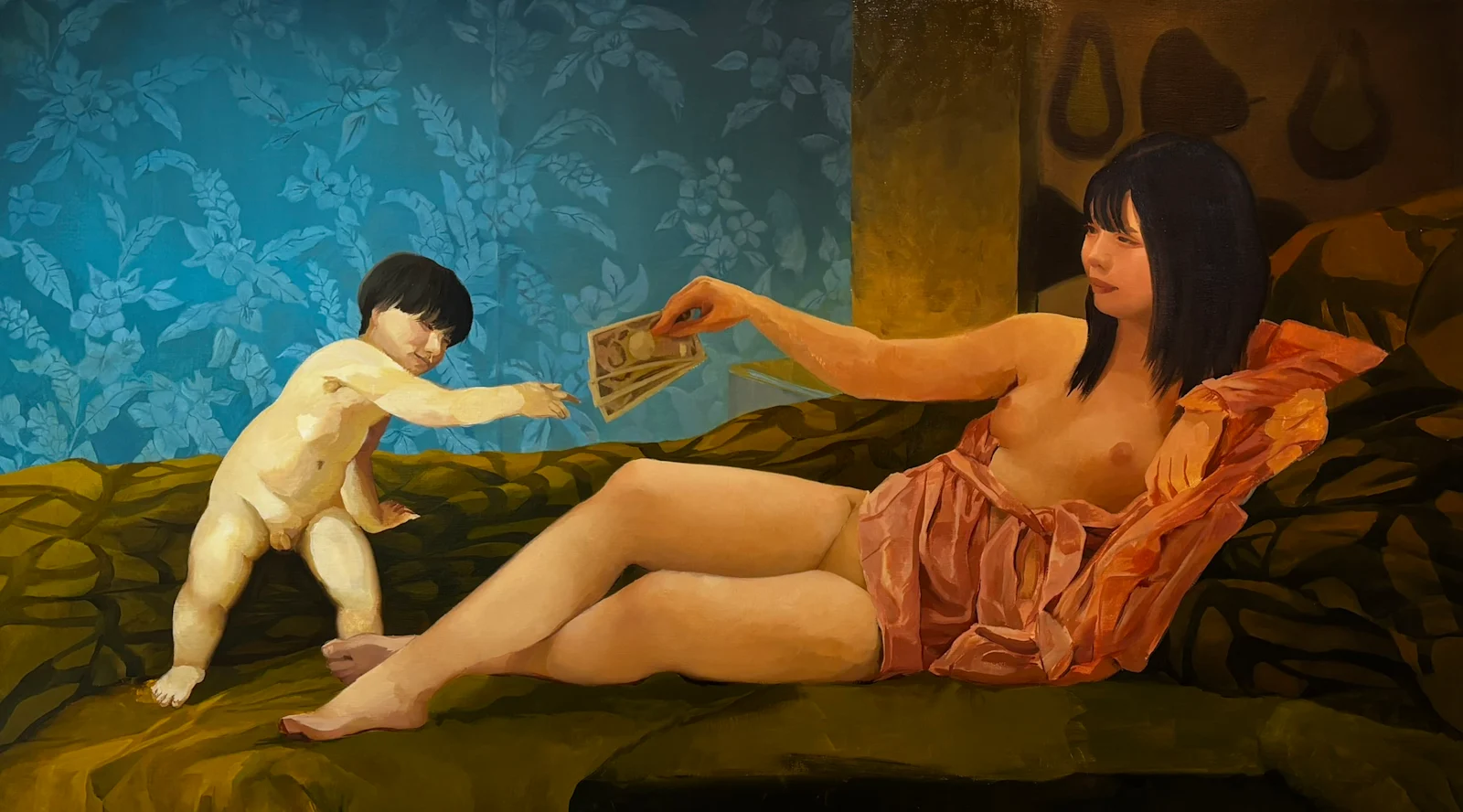
ASANO Miyabi, Venus and Her Number One in a Landscape, 2025, Oil on canvas, 2090 × 1180 mm, Asano Miyabi
The painting is faithful to its model in a way that leaves no room to stand outside it, which is what Jameson described as pastiche and considered drained of critical charge. Yet something is being read through something else here, an image made to carry a second text it never asked for, which is Owens's allegory, and Owens's allegory works by addition. Neither account survives contact with the painting on its own. Asano adds nothing, and she is not drained of anything. The fidelity is what makes the reading possible: because no distance is taken, the rhetoric has no way to disown what it is made to say. I have been calling this critical pastiche, for lack of an existing name. Asano stays faithful to art history's own procedures until they testify against themselves.
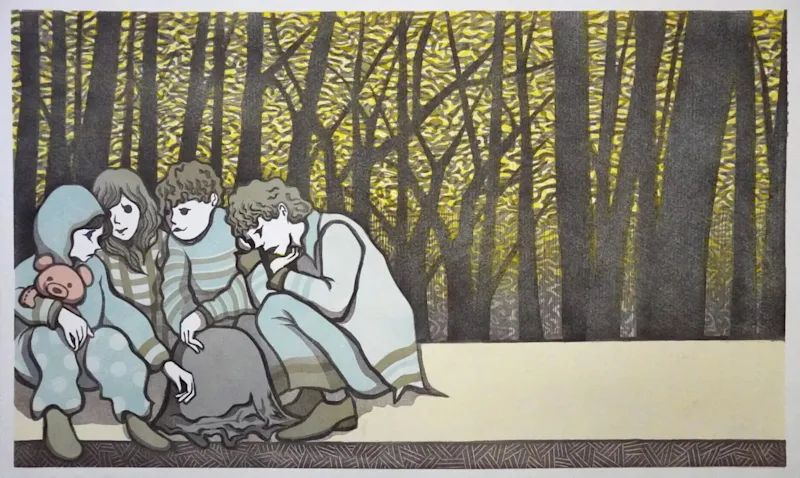
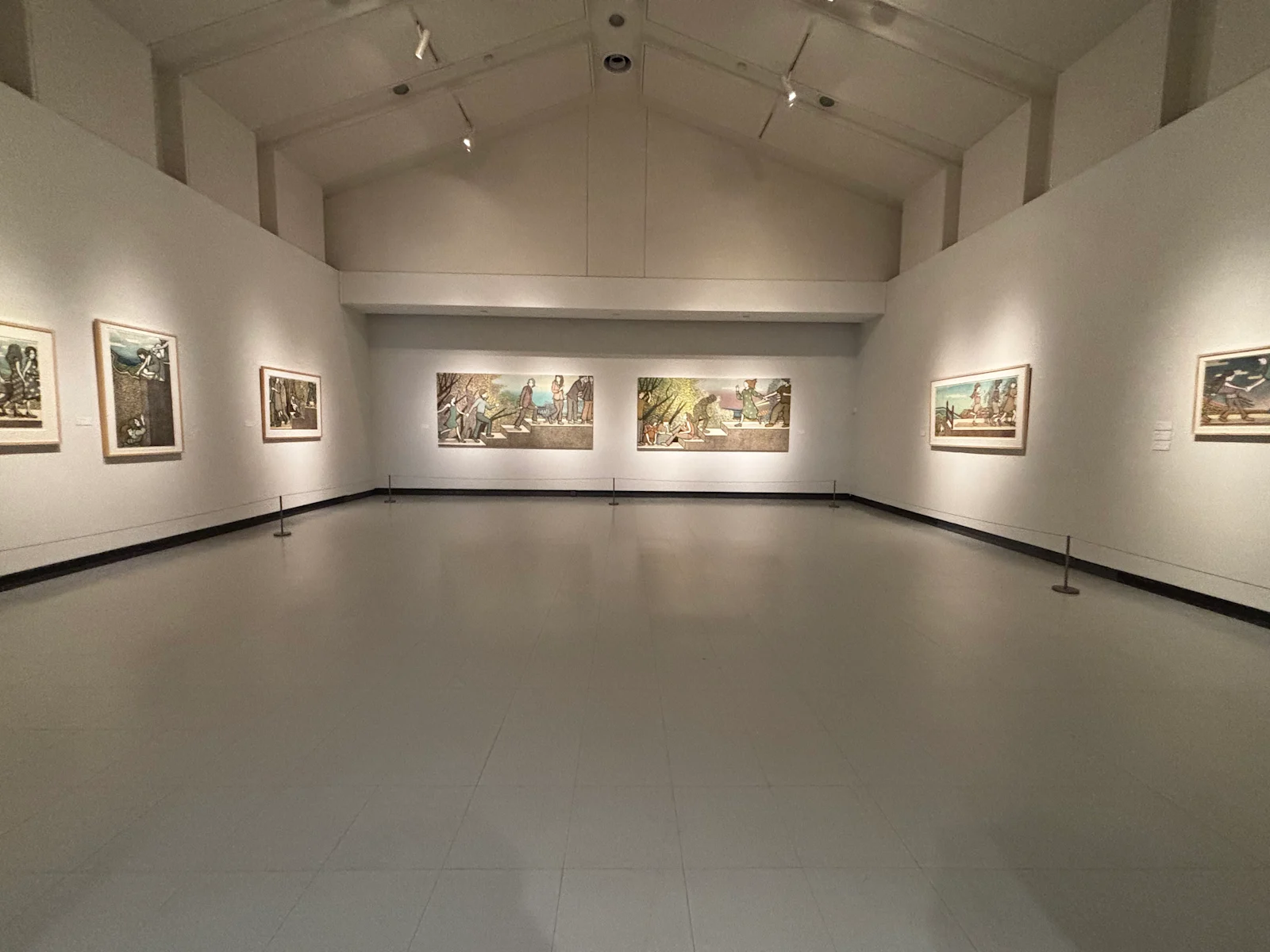
And in relief (Sapporo Art Park Museum, November 2025) and community of (aaploit, February 2025), Michimata Aoi printed staircases drawn from Ikuta Takeshi's "Kafka's staircase" as reduction prints, cutting a single block further with each pass. Ikuta took the figure from Kafka's Letter to His Father to describe the descent into poverty, where each step down is easy and the step back up is not. Once the next state is carved, the previous one is gone for good; there is no returning to it. Michimata does not argue that the staircase should be dismantled, nor that remaining on one step is virtuous. The condition is presented and left standing, as irreversible as the technique that renders it.
What unites the three is a refusal of exits. The heroic exit casts the artist as canary, the one who sees further and can therefore lead, which presupposes a confidence in grand narrative that the past several years appear to have largely let go of. The nihilist exit, built from detachment and blank repetition, treats the absence of grand narrative as license for meaninglessness and asks nothing of anyone. A third exit is closer to home and harder to see as an exit at all. Matsui Midori's MICROPOP (2007) gave Japanese art its working account of what follows the large narrative: small imagination, fragments recombined by hand, an artist who no longer speaks for an era and is lighter for having stopped. Much of what these three practices do belongs to that lineage and I would not claim otherwise. But the lightness is what they decline. Kumagae does not recombine her unit, she submits to it; Asano does not sample Palma il Vecchio, she paints as him; Michimata cannot recombine anything, because each pass destroys the block. Micropop's smallness is a way of moving freely once the large structures stopped being binding. This smallness is what remains after staying inside a structure that has not stopped being binding at all. Between the three exits, staying becomes the resistance itself: unresolved and largely silent, but more honest, to borrow Kumagae's own measure, than not staying at all. And these three are where I was able to read it, not the extent of it. Each year I walk more than ten graduation exhibitions and look at some thousands of works, and the same refusal keeps surfacing in practices with no connection to one another and none to this gallery. That is not a survey and I would not present it as one. It is more contact, nothing else: the same slow instrument run over a wider surface.
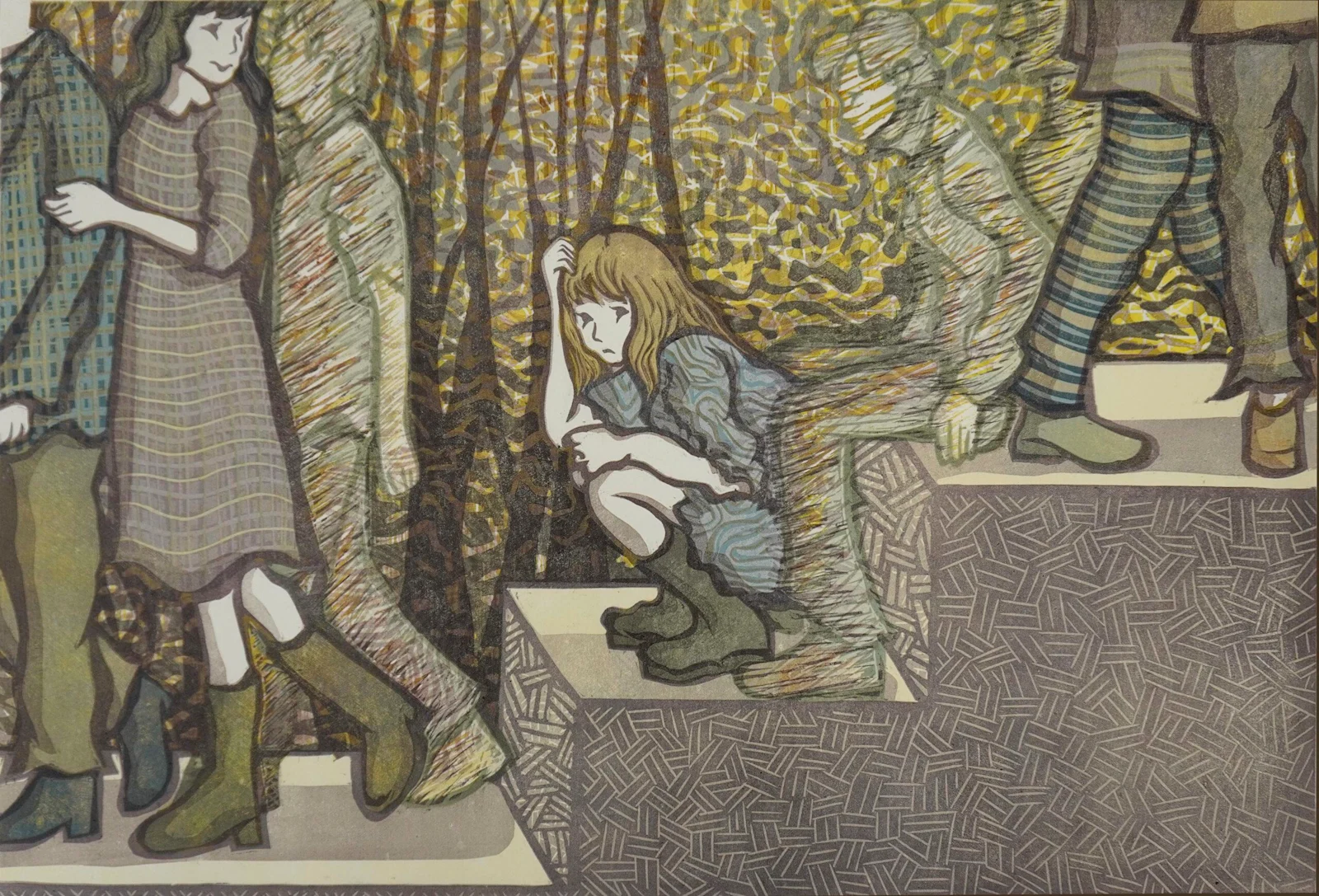
MICHIMATA Aoi, junction, 2025, Oil-based woodblock print on washi paper, 595 × 910 mm, ©2025 MICHIMATA Aoi, Courtesy of the Artist and aaploit
None of which quite answers the question in this essay's title. Read the three practices together and the honest answer to who moves the threshold is: no one, not on purpose. That admission holds something more interesting than the question. A litmus test only ever reports the color of one reaction, on a scale someone else fixed in advance. What Kumagae, Asano, and Michimata are doing looks closer to reworking the paper mid-test: not reporting whether the present is acid or base, but quietly redrawing what counts as red, what counts as blue, and eventually what will register as a reaction at all. The artist no longer predicts the age. The work revises the instrument used to measure it. Four years at aaploit did not converge on this single point, and could not have. Other practices shown here fall outside the reading entirely. Where the material or the technique is itself the concept, or where a painter refuses to look away from painting, the question is not what structure is being stayed inside, and this essay's instrument does not register them. They are not residue. They are what a different reading would have to be built for. The exhibitions were not built toward any one conclusion. They accumulated according to their own necessities, and each time I read the artists' practices back through them, some pattern becomes harder not to see. What does not change is the intention to remain a place that shows thinking still going on.
References Camus, Albert. The Myth of Sisyphus. Paris: Gallimard, 1942. Camus, Albert. The Rebel. Paris: Gallimard, 1951. Jameson, Fredric. "Postmodernism and Consumer Society." The Cultural Turn. London: Verso, 1998. Owens, Craig. "The Allegorical Impulse: Toward a Theory of Postmodernism." October, vol. 12–13, 1980. Akimoto, Yuji. Art Thinking: Bijinesu to Geijutsu de Hitobito no Kōfuku o Takameru Hōhō. Tokyo: Discover 21, 2019. Matsui, Midori. MICROPOP: The New Generation of Japanese Art. Mito: Art Tower Mito, 2007. Ikuta, Takeshi. Hinkon o Kangaeyō. Tokyo: Iwanami Shoten, 2009.