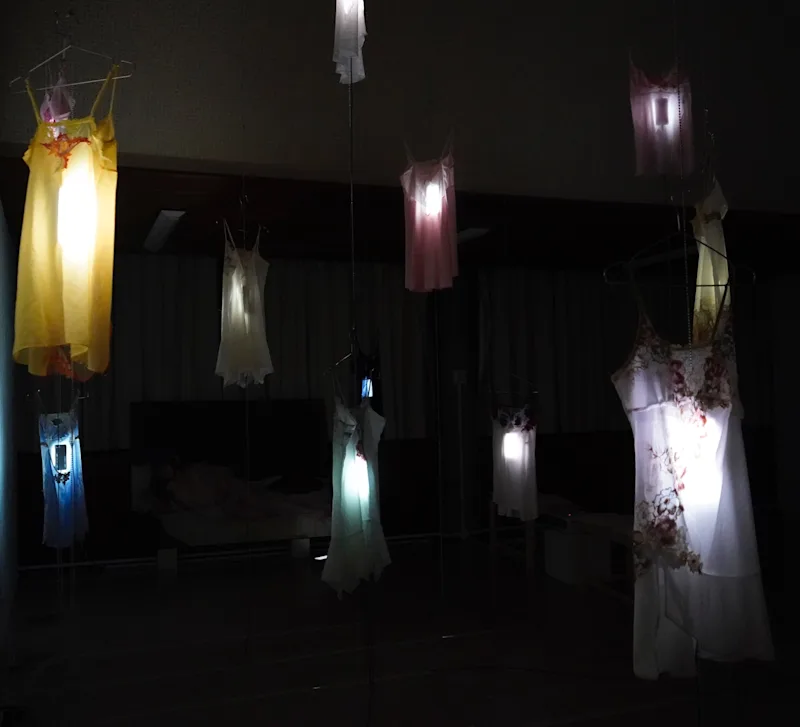
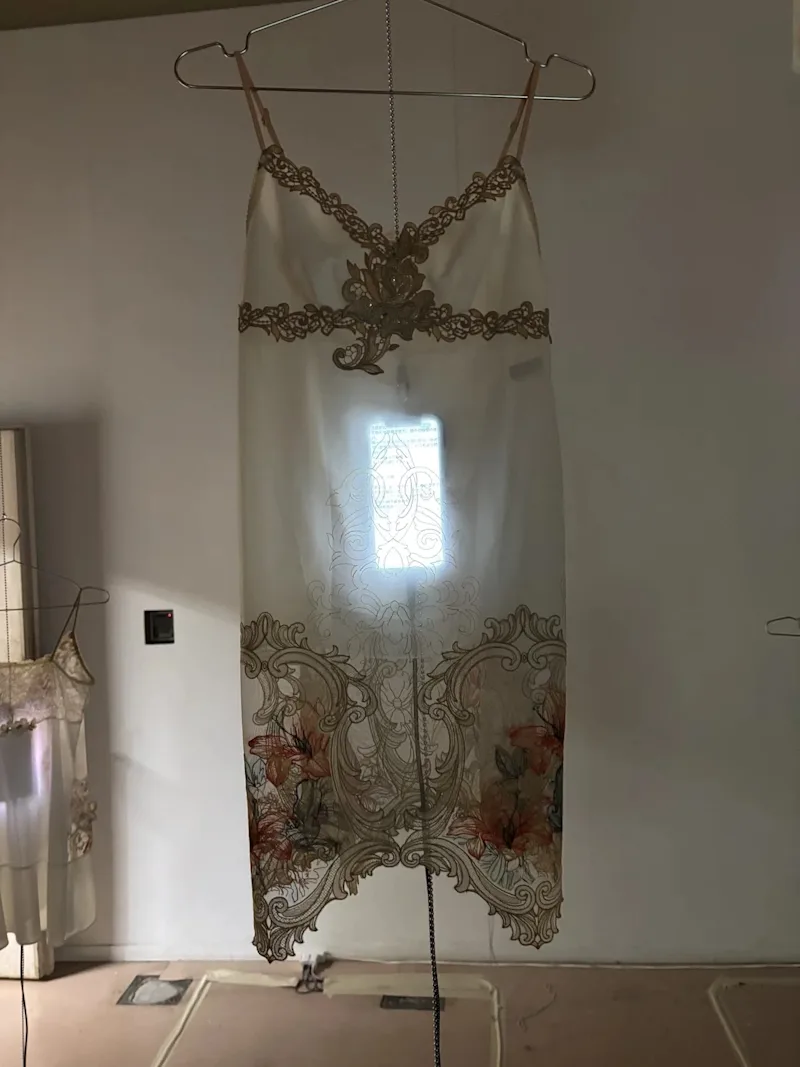
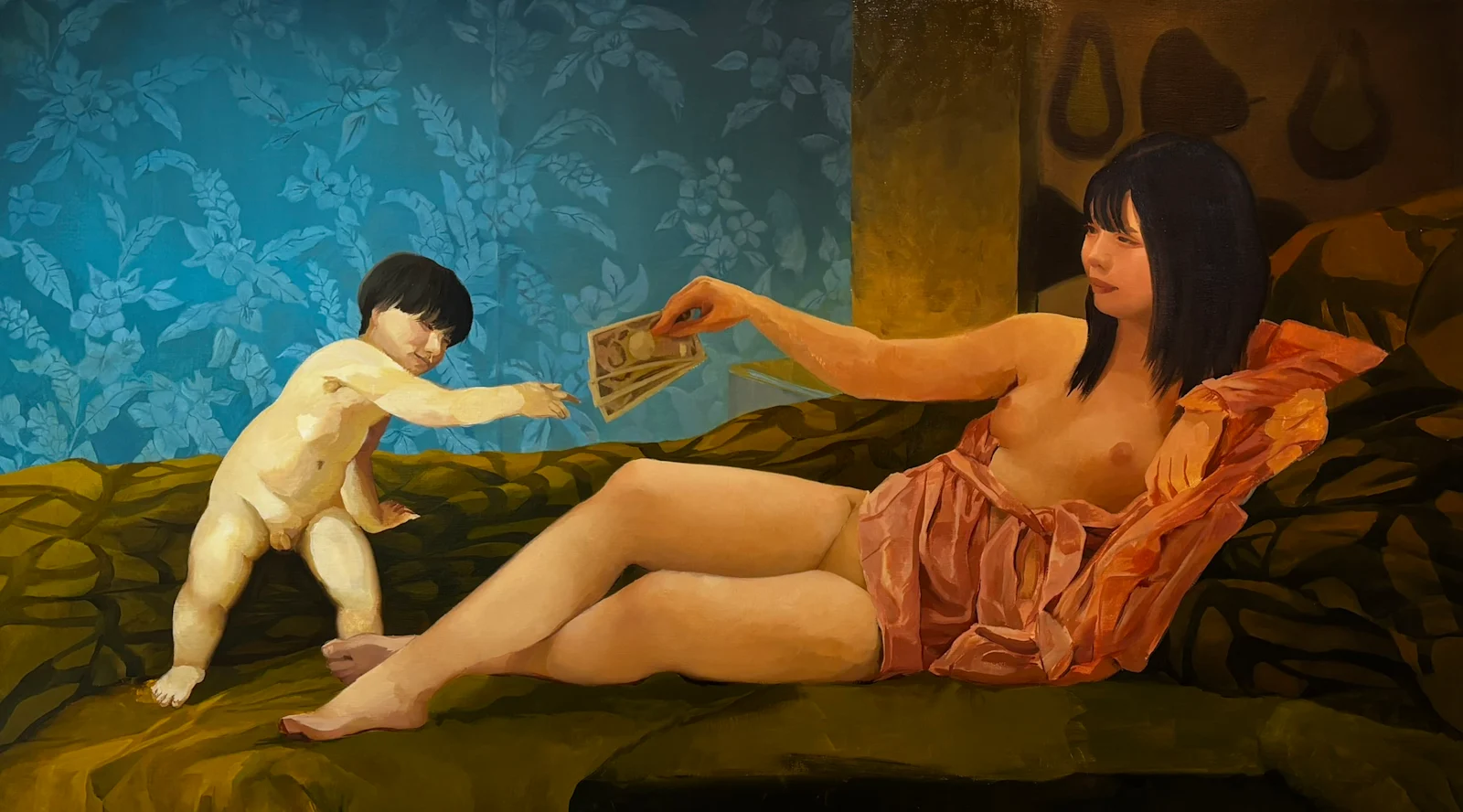
In Venus and Tantō in a Landscape, a reclining, semi-nude woman extends three ten-thousand-yen notes toward a male figure with an infant's body and an adult's head. The man reaches out as if to receive them. What first emerges is a strange overlap of familiarity and dissonance. Asano Miyabi references Palma il Vecchio's Venus and Cupid in a Landscape, but the juxtaposition of classical style and contemporary visual language introduces a quiet tension into the picture plane.
Pastiche operates through imitation—the borrowing and hybridization of styles. Yet whereas homage often carries the rhetoric of respect, the substance of pastiche remains ambiguous. Fredric Jameson sharply pointed to the danger of imitation losing its critical edge and collapsing into empty repetition. This essay explores whether Asano's practice remains within Jameson's "blank pastiche" or whether it disrupts and repositions that structure.
The Same Model, Two Faces
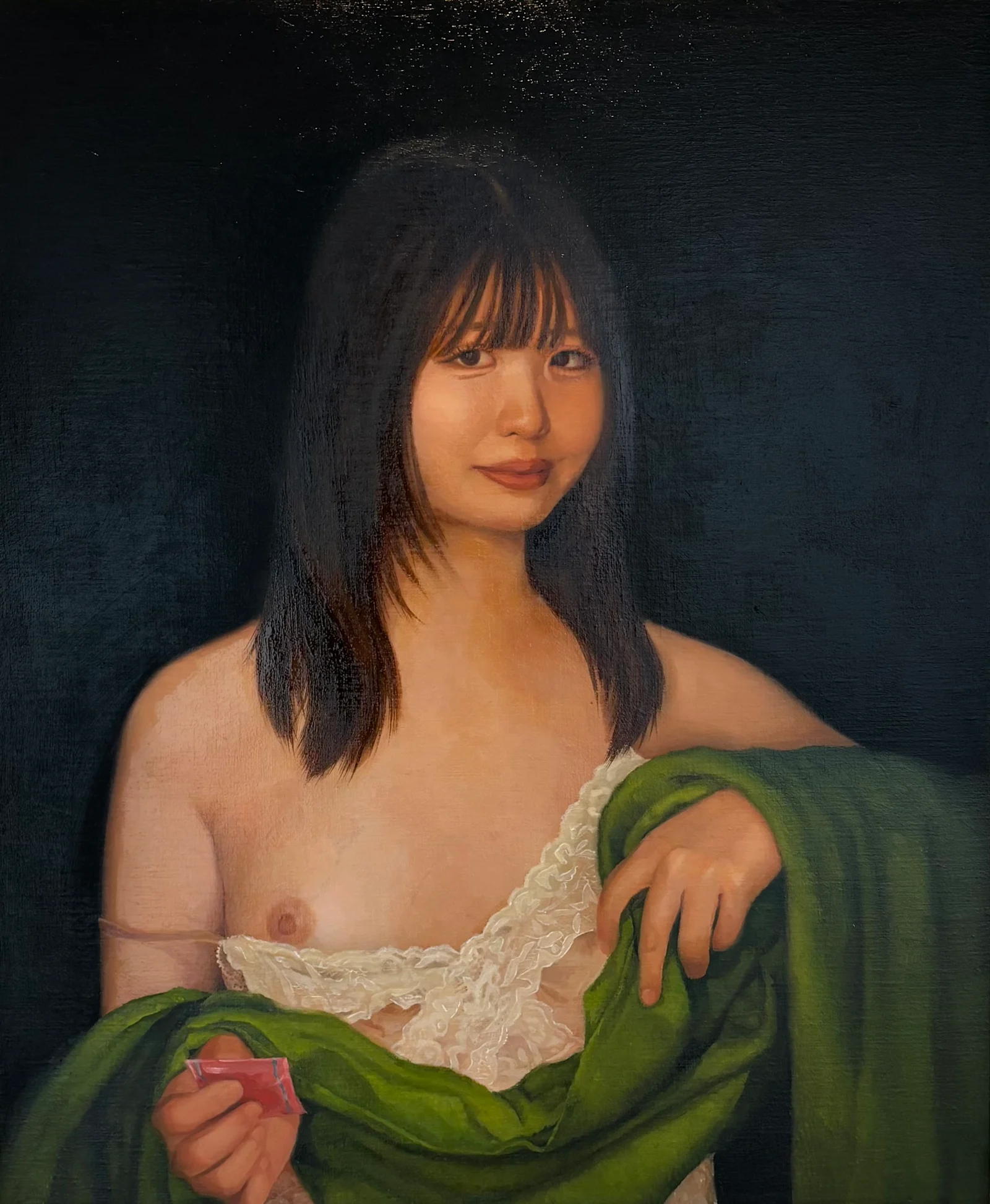
Of the five works Asano presented, Venus and Tantō in a Landscape and Woman with Beautiful Eyes depict the same model—a sex worker. Yet her expressions differ between the two. In the former, she offers a soft gaze; in the latter, her expression is somewhat hardened.
This repetition of the same model evokes the practice of Palma il Vecchio himself. Palma painted what is believed to be the same woman in two different formats: as a mythological subject (Venus and Cupid in a Landscape) and as a portrait (La Bella). Art history has inferred her identity from features such as the dimple in her chin. This woman was likely a high-class courtesan. The rhetoric of mythological subject matter functioned as a device to veil the reality of sexual and economic exchange.
Asano replaces this mythological rhetoric with "tantō"¹ and ten-thousand-yen notes, foregrounding the economic structure that had been concealed. In Palma's painting, Cupid aimed an arrow at Venus; Asano reverses this directionality, creating a composition in which Venus extends money toward the "tantō." The nomenclature of host clubs—addressing female customers as "hime"²—operates in parallel to the mythological appellations of the Renaissance. Both fictively transform economic exchange into romance.
In Woman with Beautiful Eyes, Asano further foregrounds what Palma had rendered invisible: the concept of the working face. The spring flower held in the right hand—a motif alluding to new growth and birth—is replaced with a condom. The gentle face and the working face expose the structure of emotional labor in sex work. Palma used the same model but rendered this dimension of labor invisible. Asano, by repeating the same structure, represents labor instead.
What is crucial is that Asano executes this exposure in the same style as Palma. She does not critique from outside art history. By using the same structure, she makes visible from within what that structure has concealed.
Two Points of Entry
A question arises: does the critical effect of Asano's work operate only for viewers who possess art-historical knowledge?
Asano's practice has two points of entry. Venus and Tantō in a Landscape moves from art history toward the contemporary. Viewers familiar with classical painting recognize, through the insertion of signs like "tantō" and ten-thousand-yen notes, the structure that the source had concealed. Art-historical knowledge functions as a trigger for critique.
The Shamenikki³ series operates in the opposite direction. It employs the visual language of commercial sex-industry websites—mosaic censorship and heart-shaped lock icons added to nude paintings by Titian and Caravaggio. These works are identifiable even for viewers unfamiliar with art history. Viewers are led to discover that a Renaissance masterpiece shares the same structure as images posted on sex-industry websites. Contemporary visual literacy functions as a device that enables viewers to rediscover the structure of classical painting.
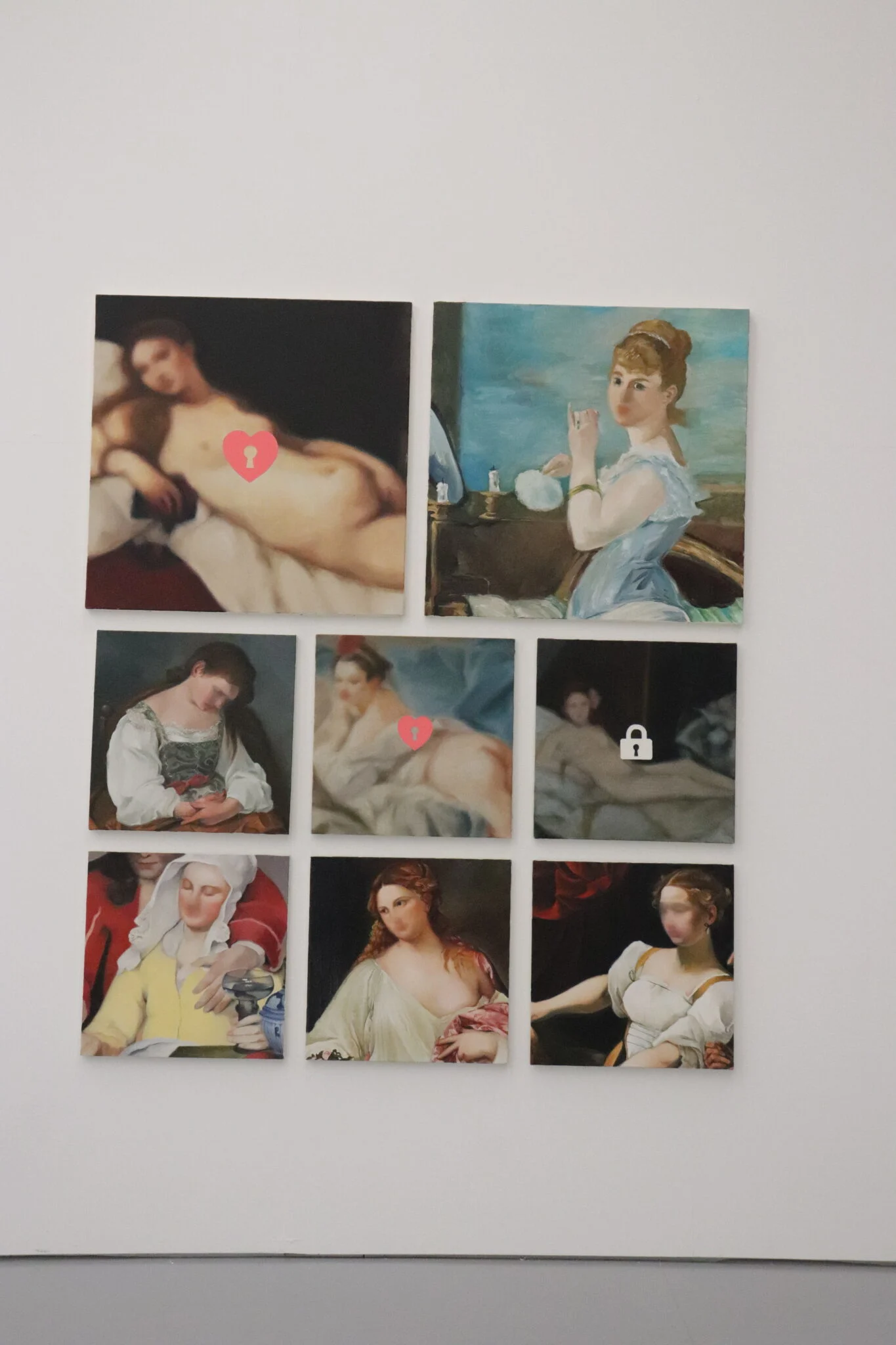
Whichever entry point one takes, the destination is the same: the structure of visual consumption and economic exchange shared by art history and the contemporary sex industry. Critique is no longer the exclusive privilege of those with art-historical education.
Jameson, Owens, and Asano
In the 1980s, Fredric Jameson diagnosed a situation in which imitation could no longer function as critique. For parody to operate, a shared norm is required. But with what Lyotard called "the end of grand narratives," that norm itself collapsed. What emerges is "blank pastiche"—the imitation of style without satirical impulse, without laughter, without a sense of the normal against which something might be comic. Style is quoted, but meaning is not interrogated.
Meanwhile, Craig Owens discerned a different possibility within practices of quotation. For him, the allegorical method adds new layers of meaning to existing images, displacing their original meaning. Quotation is not mere reproduction; through the transposition of meaning, it can be converted into critique.
Asano's practice differs from both. Asano is not adding new meaning. Rather, she makes manifest—through the style itself—meanings already immanent in the source, meanings that had been concealed within art history's stylistic rhetoric.
Asano adheres to style: the composition of classical painting, the smooth surfaces. But simultaneously, she substitutes signs. Cupid becomes "tantō"; the arrow becomes ten-thousand-yen notes. Stylistic adherence and semiotic inversion are executed simultaneously. And this inversion is in fact exposure—Asano makes manifest, through the style itself, structures that already existed in the source.
In Venus and Tantō in a Landscape, we are looking at a beautiful classical painting. At the same time, we are looking at the exposure of economic and sexual structures that art history has concealed. It is not one or the other. Both are simultaneously established, maintaining their tension. The persistence of this paradox is the intensity of Asano's practice.
Critical Pastiche
Asano's work disrupts the concept of blank pastiche as formulated by Jameson. Style is certainly imitated. But this imitation is not neutral repetition lacking sensitivity to history. It is refunctionalized as a means to make visible the structures that style has concealed.
I propose to call such practice "critical pastiche." It operates through stylistic adherence—classical styles and historical visual codes are consciously adopted, executed not as external criticism but as internal operation. Through that adherence, economic, sexual, and institutional structures already immanent in the source are made visible; this is not the addition of meaning but the lifting of concealment. Critique of the present and critique of the history that has reproduced these structures arise simultaneously, so that the form of imitation itself becomes a device that amplifies critique. And because viewers with art-historical education and viewers with contemporary visual literacy are both guided from different entry points to the same structural exposure, the reach of that critique extends beyond any single literacy.
Asano's practice is the reactivation of critique through imitation, appearing after imitation had lost its critical capacity. Past styles are no longer merely objects of quotation. They are reactivated as media that expose the structures they themselves had concealed. Critical pastiche is a form of critique that appears after the death of imitation, and Asano Miyabi's work offers a compelling example of this practice.
Notes
¹ Tantō (担当): A term used in Japanese host clubs to refer to a host who serves a particular female client. The word literally means "person in charge."
² Hime (姫): Literally "princess." In host clubs, female customers are addressed as hime, a rhetorical device that transforms economic exchange into the fiction of courtly romance.
³ Shamenikki (写メ日記): "Photo diary." In the Japanese sex industry, workers post daily photos and updates on commercial websites to attract clients, typically featuring selfies with mosaic censorship and decorative elements like heart-shaped lock icons.
References
Jameson, Fredric. "Postmodernism and Consumer Society." The Cultural Turn. London: Verso, 1998.
Lyotard, Jean-François. The Postmodern Condition. Minneapolis: University of Minnesota Press, 1984.
Owens, Craig. "The Allegorical Impulse: Toward a Theory of Postmodernism." October, vol. 12–13, 1980.