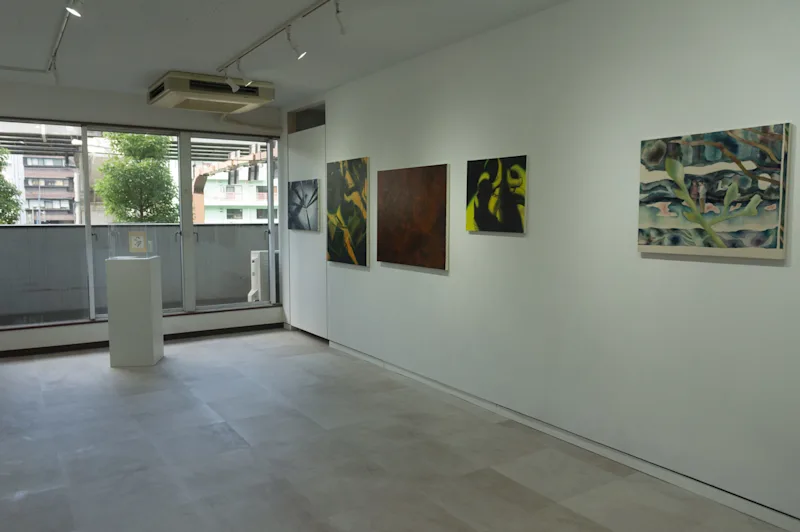
I first encountered Matsuda Nayuko's work at the Takanodai campus graduation exhibition. The Five Art Universities Exhibition offered a second encounter—a different space, a different light, and the opportunity to engage with the work again on its own terms.
The large canvas draws the viewer's gaze quietly, without spectacle. The colors are simultaneously vivid and pale: blues and greens across the surface, with pink and purple appearing intermittently. Acrylic, watercolor, and mineral pigments are combined in a technique that allows the pigments to bleed into one another, deliberately blurring boundaries between forms.
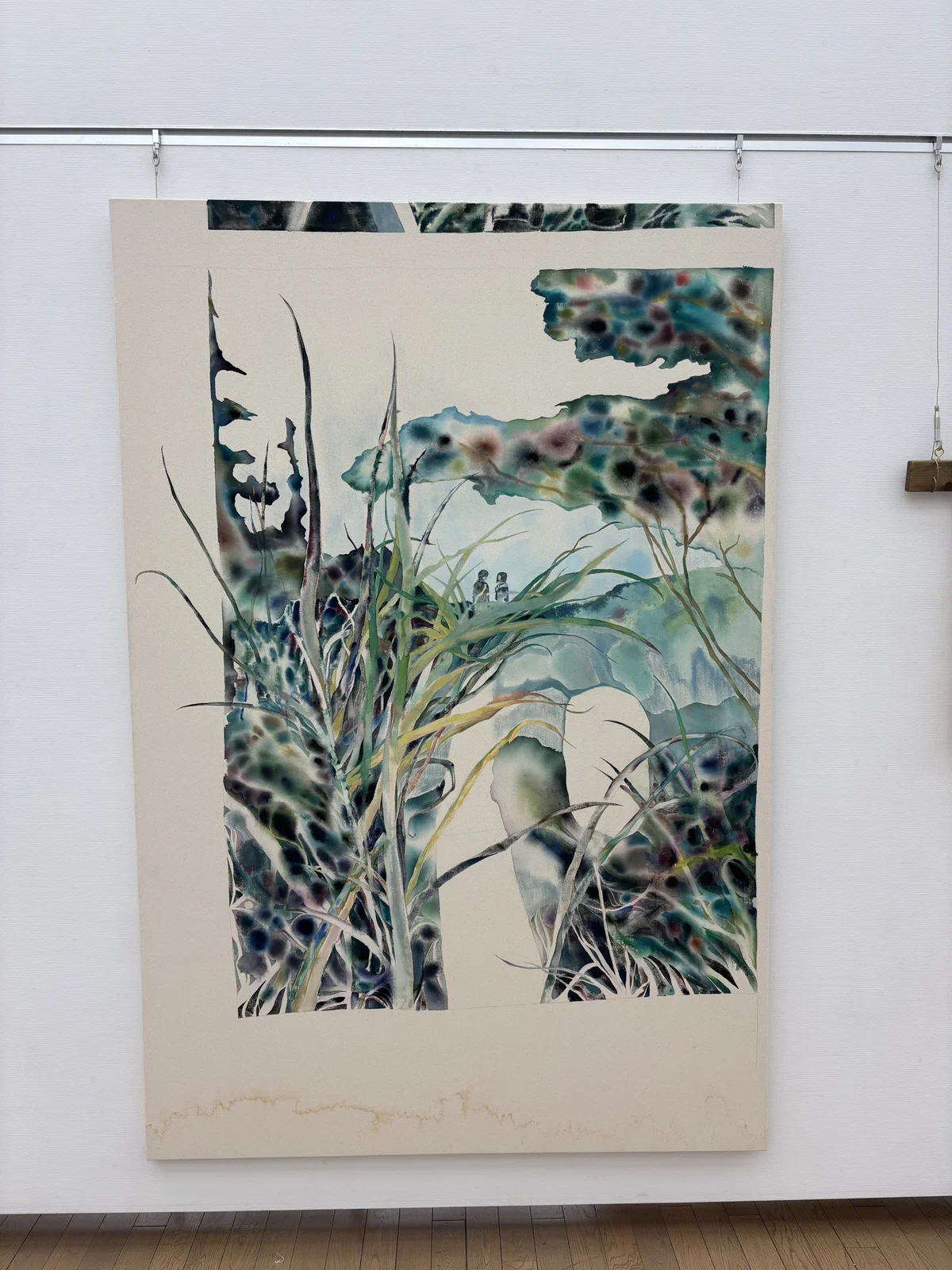
The viewer's eye moves through the composition in sequence. Susuki-like plants in the foreground come first. Then two small human silhouettes at the center, facing each other. Then the forest beyond. The figures do not dominate the landscape; they inhabit it, present but not insistent, slightly distinct from the vegetation surrounding them.
Several voids exist within the composition. The blank space in front of the figures reads as a path. A gap in the lower center-right resists easy interpretation—its function is not immediately apparent, and that resistance is productive. These spaces do not wait to be filled. They sustain an openness that continues after the viewing ends.
The title carries this multiplicity into language. Yuri-shiro-iro no evokes yuri (lily) and shiro (white), yet the sound of yuri also recalls yureru—to sway or fluctuate. The semantic instability of the title resonates with what the painting does visually: holding forms in motion, keeping boundaries from settling, allowing meaning to remain unfixed.