The brand logo is a connective apparatus for desire. The Nike Swoosh, the Adidas three stripes, the Reebok Vector, the Champion C. These signs mediate a sense of belonging to a team, a generation, a certain corporeality and continue to sustain that connection even after the garment has left the body. Used clothing retains traces of its former wearer's body; the logo attends those traces as the sign that mediates desire.
Kumagai Ayano selects such used garments as "traces of desire already formed." She intervenes through embroidery made by industrial sewing machine. The stitching itself is executed by the machine; the artist's decisions concentrate on composition where on the garment, and in what form, a plant is to be placed. To summon the figure of a plant at industrial speed. That contradiction is never resolved, and settles onto the surface of a single cloth.
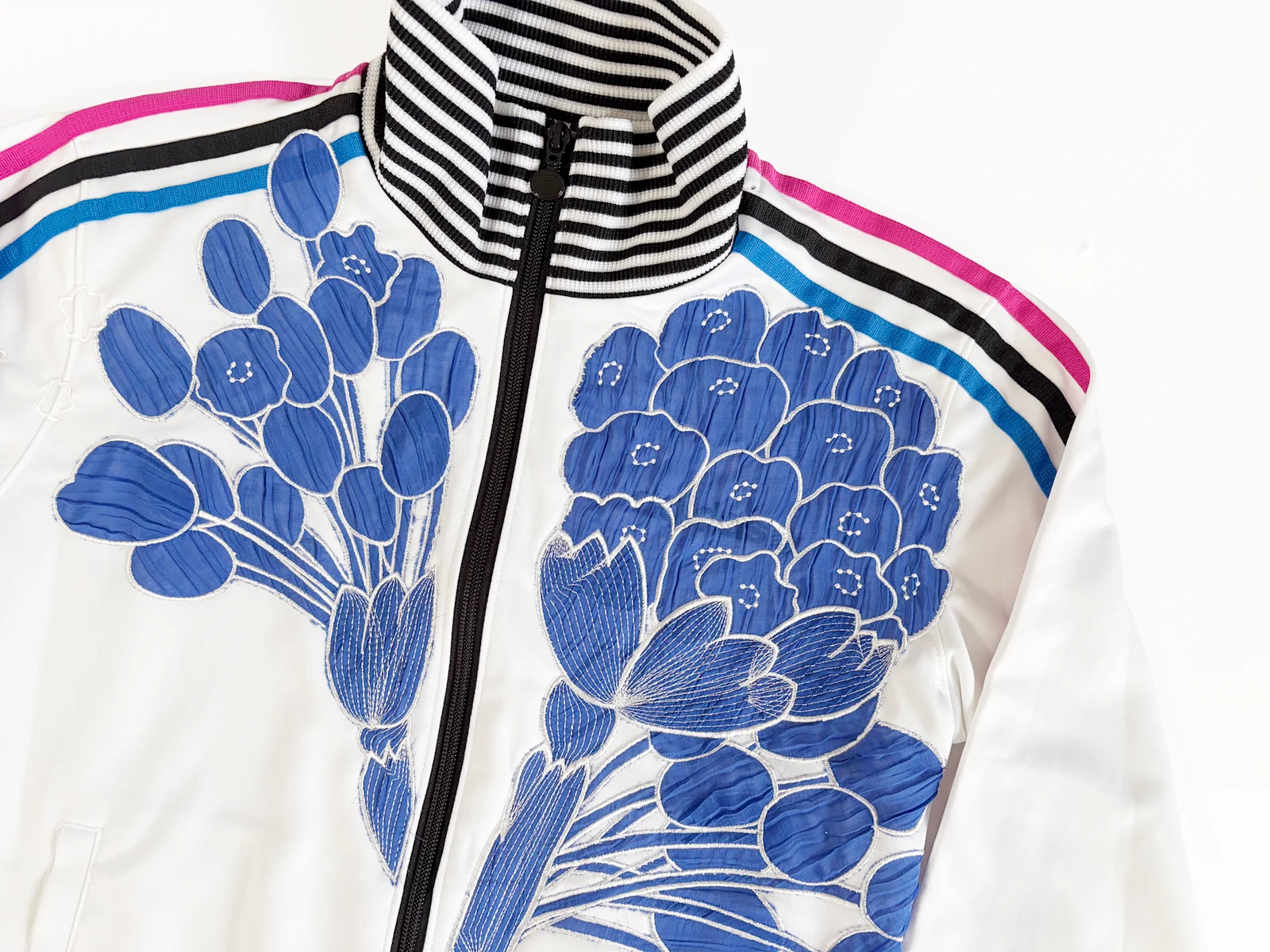
The plants Kumagai depicts do not exist. Already in her first solo exhibition, altitude, forms that satisfied the conditions of being a plant — stem, petal, cluster — were placed across the picture plane while remaining unidentifiable as any known species. What Kumagai introduces, then, is not the record of a particular ecosystem but the temporal structure that is the plant itself: growth, circulation, the rhythm of slow overwriting.
Her practice is not a critique of brands. It is an attempt to layer another stratum within the structure through which desire circulates. The logo is not erased; it remains beneath the fictive petals, as if breathing. Not destruction but coexistence. Two times overlap on the same cloth.
In 1994, the artist Felix Gonzalez-Torres collaborated with the French brand agnès b. to produce a T-shirt bearing the text "Nobody Owns Me." In the midst of the AIDS crisis, it was released as a declaration in the present tense against a power that was consuming and excluding bodies.
Kumagai's practice departs from the past tense. It accepts the premise of "already having been owned by someone" and stands on that ground. What it takes on, in other words, is the fact that the era in which declaration could still arrive in time has ended. Gonzalez-Torres could refuse in the present tense because the boundary between "owned" and "not owned" still moved at a pace language could track. The present moves faster. Through social media and algorithms, connection to and disconnection from a given brand now occur in cycles of months, sometimes weeks. What to belong to, what to reject before the contour can solidify, the next desire has already overwritten it. Identity itself has become an object of rewriting.
Kumagai's response, then, is not a declaration but the insertion of a different temporal axis. In the guise of fictive plants, she places on the picture plane the quality of time that algorithms find hardest to control. To high-speed rewriting, she responds with slow overwriting.
One further observation has to be made: the sight of plants overgrowing a logo evokes a scene from which people have disappeared. It approaches the structure of ivy winding through ruins. But what flourishes in Kumagai's picture plane is none of the plants we know. What spreads across signs that have lost their readers is a vegetation that does not yet have a name. Brand logos only function as signs when there is someone to read them. In Kumagai's work, signs that require reading and life that holds together without being read unknown life, at that are set side by side. The dependence of the former and the autonomy of the latter coexist on the same cloth.
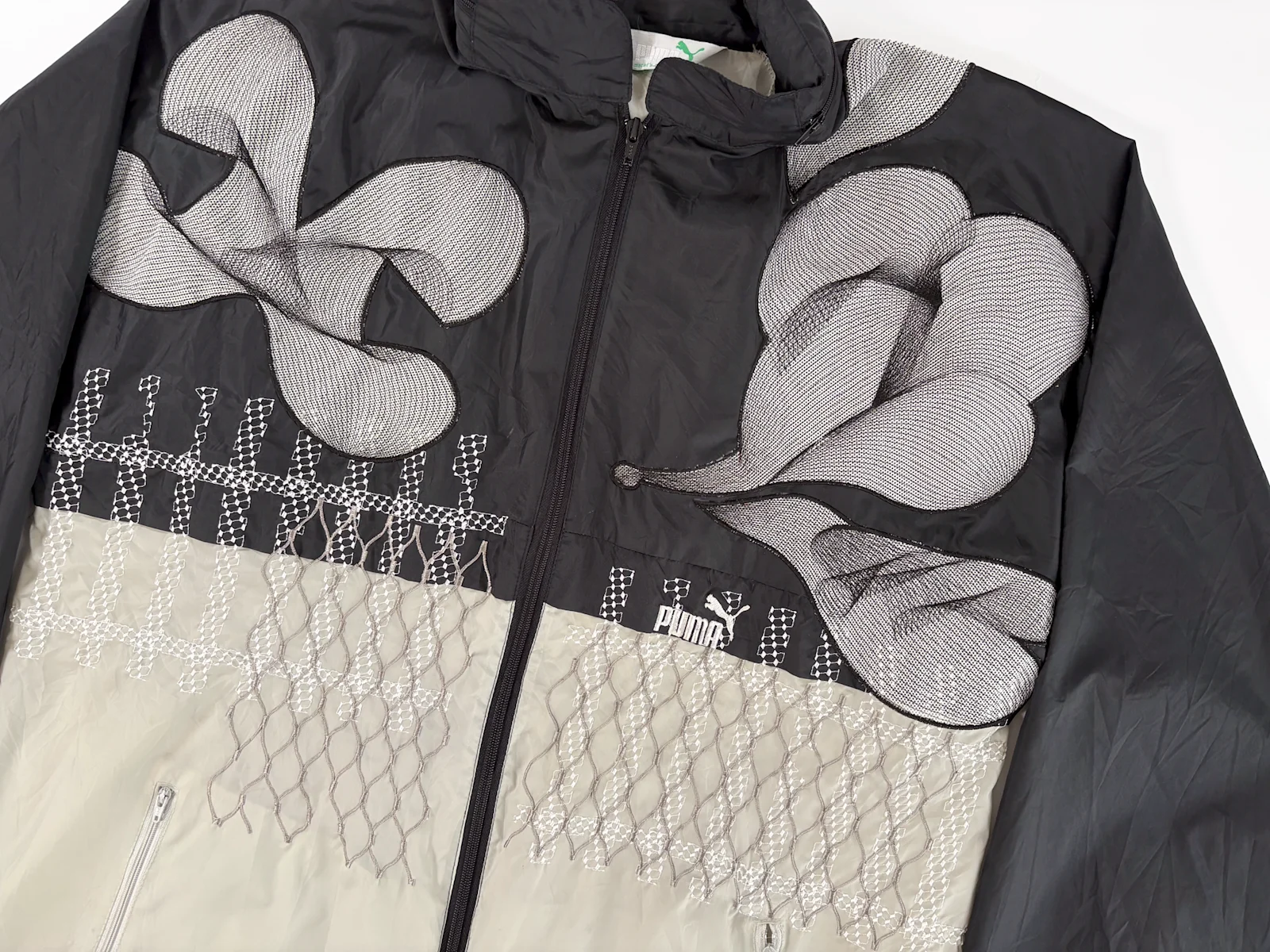
The exhibition is titled Tidal — Logos on the Flat. Desire ebbs and flows like the tide, and when it recedes, logos are left behind on the flat. There, the brand hierarchy that operated at high tide no longer functions. The artist takes on this flatness from within the work, pricing every piece the same: an attempt to return signs the market has stratified to a single water level, inside the space of the exhibition. And it draws even the conduct of the viewer's gaze which work one stops in front of into the work itself. We mean not to read the logo, and we read it all the same.
On Kumagai's cloth, at least three tenses coexist: the past of desire inscribed in the used garment, the present of a logo that still functions, and the time not yet arrived, indicated by the fictive plants. The overlap offers no answer. It remains open, laid upon the cloth.