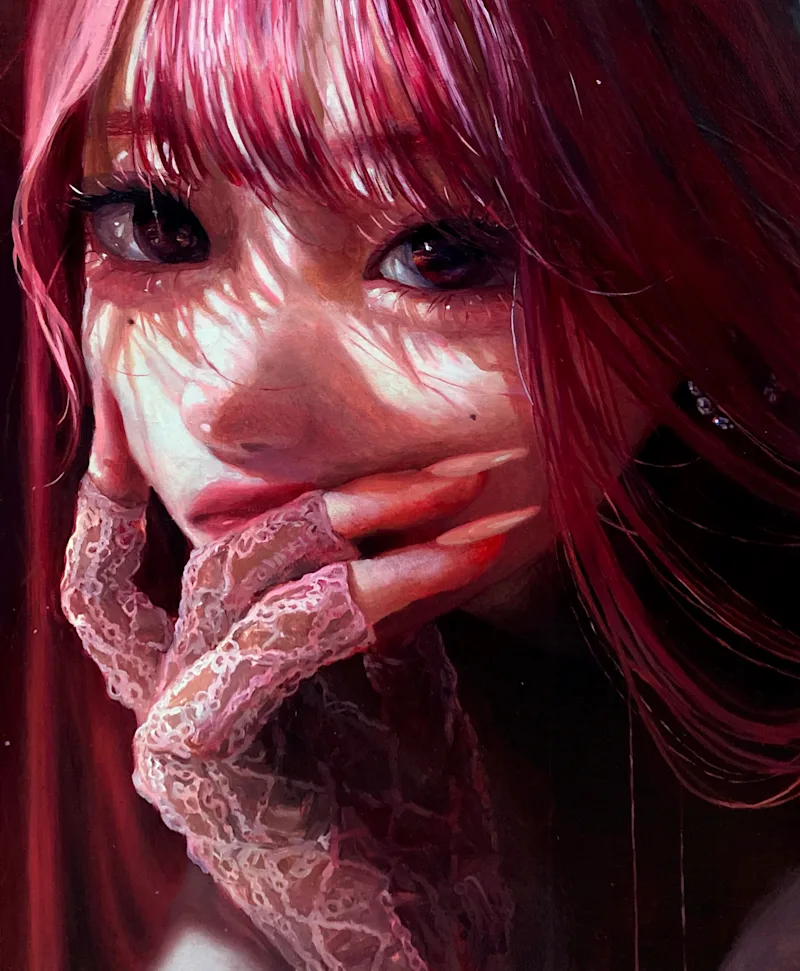
When Tanabe Motoha begins a portrait, the process starts with conversation. From there, the research extends beyond the subject to family, friends, and strangers who evoke something of that person. Photographs accumulate across ages and genders; the archive often exceeds ten thousand images. From these, fragments of expression and gaze are selected and woven into a single face.
The finished portrait is not a reproduction of one person's appearance. Nor is it a fictional composite.
The finished portrait is not a reproduction of one person’s appearance. Yet it is not a completely fictional character either.
What is it that recognizes a person? Not the image of one individual, but the totality of many relationships. To exist as a person is inseparable from being seen, remembered, and recognized by others. This process of making is an attempt to bring that structure into visibility on the painted surface.
Layer by layer, Tanabe builds with precision. The thickness of the paint records the accumulation of decisions̶one resemblance chosen, another set aside. The weight that remains on the surface is the trace of sustained attention directed toward a single life. Through portraiture, Tanabe confronts the question of what it means to recognize another person.