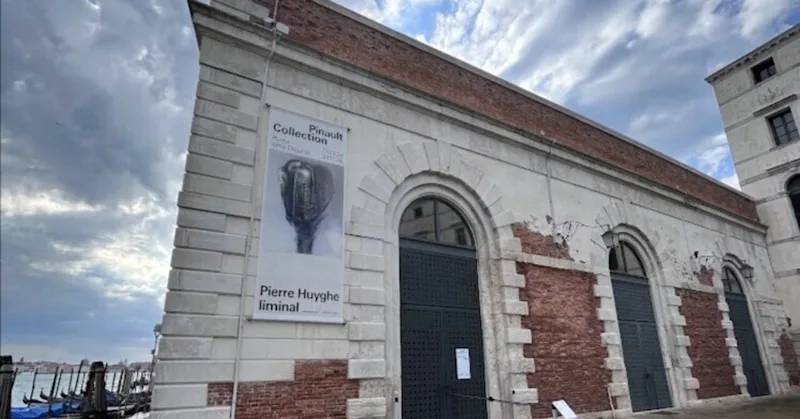
The 60th Venice Biennale took the title Stranieri Ovunque / Foreigners Everywhere from a Turin collective that fought racism and xenophobia in Italy in the early 2000s. I visited in early May 2024, three days across Giardini, Arsenale, and the surrounding city. What follows is not a comprehensive survey but a record of what stayed with me.
The Incomplete Sentence
At Arsenale, I encountered the sign: 「どこでも外国人」.
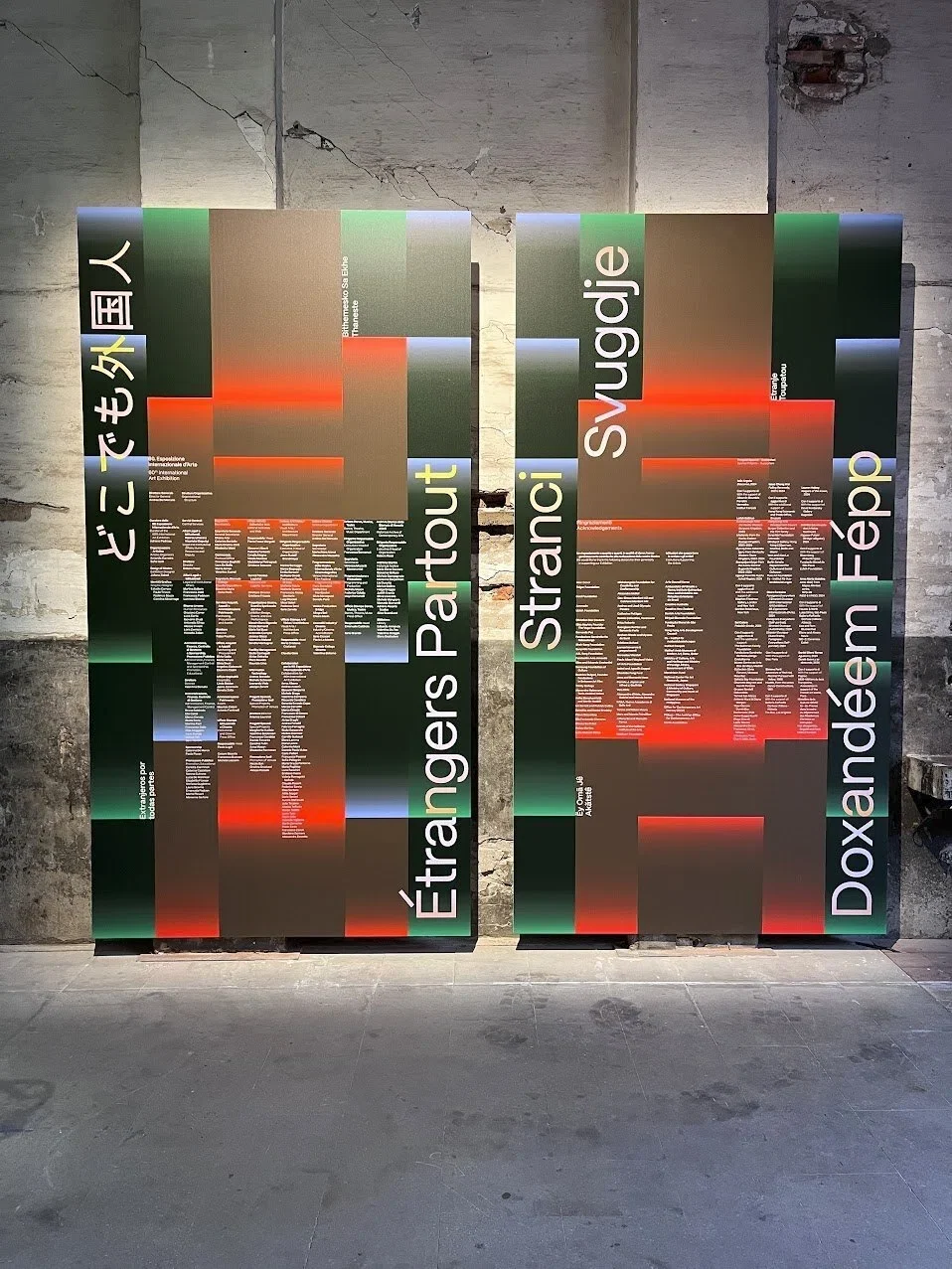
The English reads "Foreigners Everywhere." The Japanese is closer to "foreigners, everywhere"—a fragment, without the verb that would anchor it as a statement. Whether this was mistranslation or intention, I cannot say with certainty. But I immediately recalled the 2019 Okayama Art Summit, IF THE SNAKE—a title also deliberately withheld from completion.
I came to art from a different field. The word that surfaced was not from art criticism but from my previous life: debugging—locating errors in systems that otherwise run unexamined. Standing before an incomplete sentence in a city where I was, in fact, a foreigner, the Biennale felt like a debugging process applied to perception itself.
Venice is a global tourist destination where languages overlap constantly—German, French, Italian, English, Chinese, and many others. For Venice locals, foreigners are indeed everywhere. When I return to Japan, currently experiencing what is called overtourism, foreigners are everywhere there too. The incomplete sentence sits differently depending on where you stand within it.
During my journey to Venice, I had experienced being treated as invisible as an Asian—something I had not noticed as sharply during business trips to Germany or America, perhaps because I had the company's backing then. Culture and codes built up through accumulated daily life sometimes show exclusive aspects. The Biennale's theme named this without resolving it.
Yuko Mohri and the Circulation of Time
At the Japan Pavilion, Yuko Mohri's installation used decaying fruit with electrodes inserted, causing light bulbs to flicker as if transmitting a pulse. A faint smell of decomposition permeated the space. Water circulation machinery produced operational sounds alongside audio from speakers. The skylights were designed to invite rain—a mechanism for coexisting with nature rather than excluding it.
I returned on the third day during heavy rain, hoping to see how the work changed. By the time the pavilion opened at 11 AM, the rain had completely stopped. The work I saw was a version of itself. Another version existed only in the time I missed.
Sound as Equal to Sight
Across many national pavilions, I noticed one thing: sound was treated with the same intentionality as visual experience. Not necessarily music—environmental sounds, machinery, video audio, tones that resisted categorization. The German Pavilion filled its spaces with smoke and light traces, with footage alternating between a spaceship and ritualistic forest dancing. The French Pavilion presented relationships between resin, thread, and objects alongside sounds that couldn't quite be called music. In exhibition after exhibition, the auditory register was not background but structure.
Mapping Journey and What Continues Outside
What left the strongest impression at Arsenale was Bouchra Khalili's Mapping Journey. The Moroccan-French artist presents interviews with immigrants—including undocumented ones—who came to Italy. The first interview I encountered was with someone from Bangladesh. Paid money to brokers. Reached Eastern Europe and was sent back. Crossed Africa. Aiming for Italy by boat from Libya or Tunisia. Shipwrecked and rescued by Australian ships. Near death in high mountain passes. Through all of this, the interviewee calmly drew lines on a map as if simply recalling a journey. These lines were presented as drawings.
They came to Italy but hate Italy. They want documents. The ultimate goal is Northern Europe.
Later, I stopped at a shop to buy souvenirs. It was run by someone from Bangladesh—not a street stall but an actual store. We communicated in English. When I tried to pay, he said cash only: a bank approval issue. When I told him I was from Japan, he seemed happy and spoke rapidly about himself.
What I had seen in Mapping Journey was only part of it. Many people had made that journey. The lines on the map continued outside the exhibition, into the city, into the shop, into the conversation.
Teresa Teng and Hiroshima
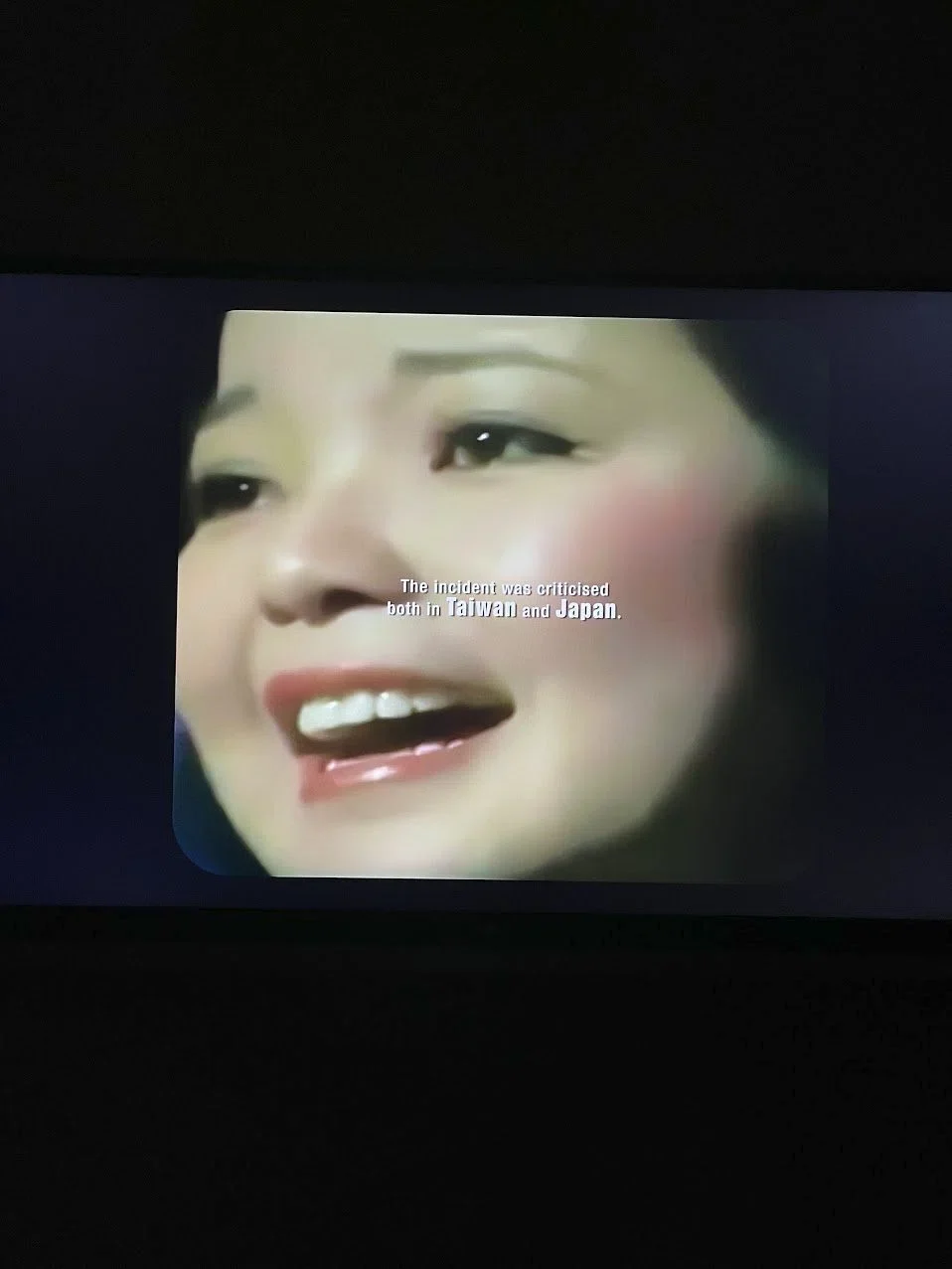
At Arsenale, Thunska Pansittivorakul's Damnatio Memoriae caught my attention. When I passed, black and white footage of post-Hiroshima atomic bomb aftereffects research was showing—a burned boy's face. Hiroshima came to mind immediately, which I recognized as the operation of cultural codes. The work then presented pre-war Hiroshima footage and argued that Teresa Teng eased Japan's post-war isolation, serving as a bridge for diplomatic relations with Taiwan, China, Korea, and Southeast Asia. The video played "Toki no Nagare ni Mi wo Makase."
I couldn't watch it to the end. I would like to return to this work.
What the Biennale Does
The Venice Biennale is too large to see fully. What it offers is not comprehensiveness but collision—with works, with languages, with one's own position as a viewer who is also, always, a foreigner somewhere.
Stranieri Ovunque. Foreigners everywhere. The sentence remains incomplete. That may be precisely the point.