Moonwhite Castle was installed directly on the floor at the far end of the sculpture building at Tokyo Zokei University's 2023 graduation exhibition. Not elevated, not centered—positioned as if it had simply arrived there.
In the large space of the building, the figure does not dominate. At one meter, it occupies almost nothing. Yet it pulls attention from a distance in a way that the surrounding works do not. The draw is not scale but specificity—something in the surface, the downward gaze, the stillness that is not quite inert.
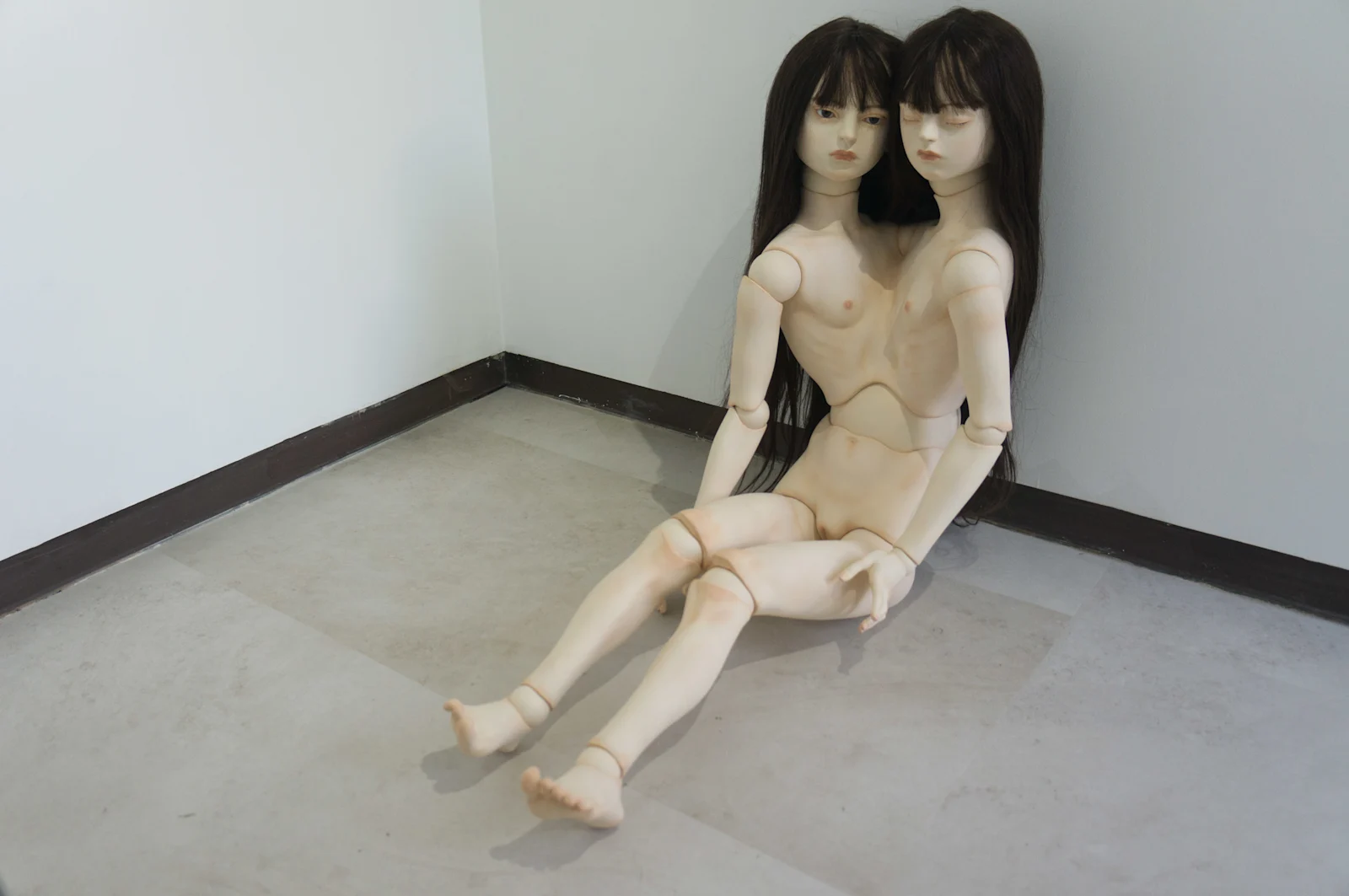
The sculpture is a ball-jointed figure bearing two heads on a single nude body. From the chest downward, the body is unified; above, it bifurcates. One face holds open eyes directed toward the floor. The other remains closed. The effect is neither grotesque nor theatrical. It produces a sustained psychological instability in which the viewer is simultaneously addressed and withheld from.
Constructed from stone powder clay, modeling paste, oil paint, and human hair, the surface resists the neutrality of academic plaster. It is tactile, faintly organic, almost breathable. The presence of real hair pushes toward the corporeal, while the visible ball joints hold the work back from illusion. The figure remains visibly assembled. This tension—between bodily immediacy and structural artificiality—is where the work operates.
The two heads do not represent opposition. They destabilize the assumption of singular identity. The shared body below refuses binary reading; identity here is not divided but layered, simultaneously present in incompatible states.
At roughly one meter in total height, the seated figure does not meet the viewer's gaze. The open eyes face downward, toward the floor. To encounter them fully, the viewer must crouch, lean in, adjust. The sculpture does not come forward. It remains where it is, requiring the viewer to descend. The open eyes are legible as eyes, but they yield nothing. They face outward without directing attention. The viewer looks in; nothing is returned.
The work's title, Geppaku no Shiro—rendered in English as Moonwhite Castle—draws not from fairy tale but from a traditional Japanese color name: geppaku, the pale blue-white of moonlight. The word names a quality of surface rather than a narrative. The work's clay and paint seem calibrated toward it: cool, diffuse, neither warm nor stark.
The work intersects with Pierre Huyghe and Philippe Parreno's No Ghost Just a Shell (1999–2002), in which AnnLee—a minor manga character purchased from a Japanese animation company and destined for disposal—was distributed among artists as an empty vessel awaiting content. Where AnnLee's emptiness was dispersed across multiple practices, Sato concentrates it: a single physical presence, structured for articulation, open to projection, resolved into nothing.
Moonwhite Castle does not argue for the legitimacy of its medium. It proceeds as sculpture, fully aware of its own ambiguities. The body it constructs contains multiplicity without resolving it. That refusal to clarify is the work's critical position—and, in this early piece, already fully formed.