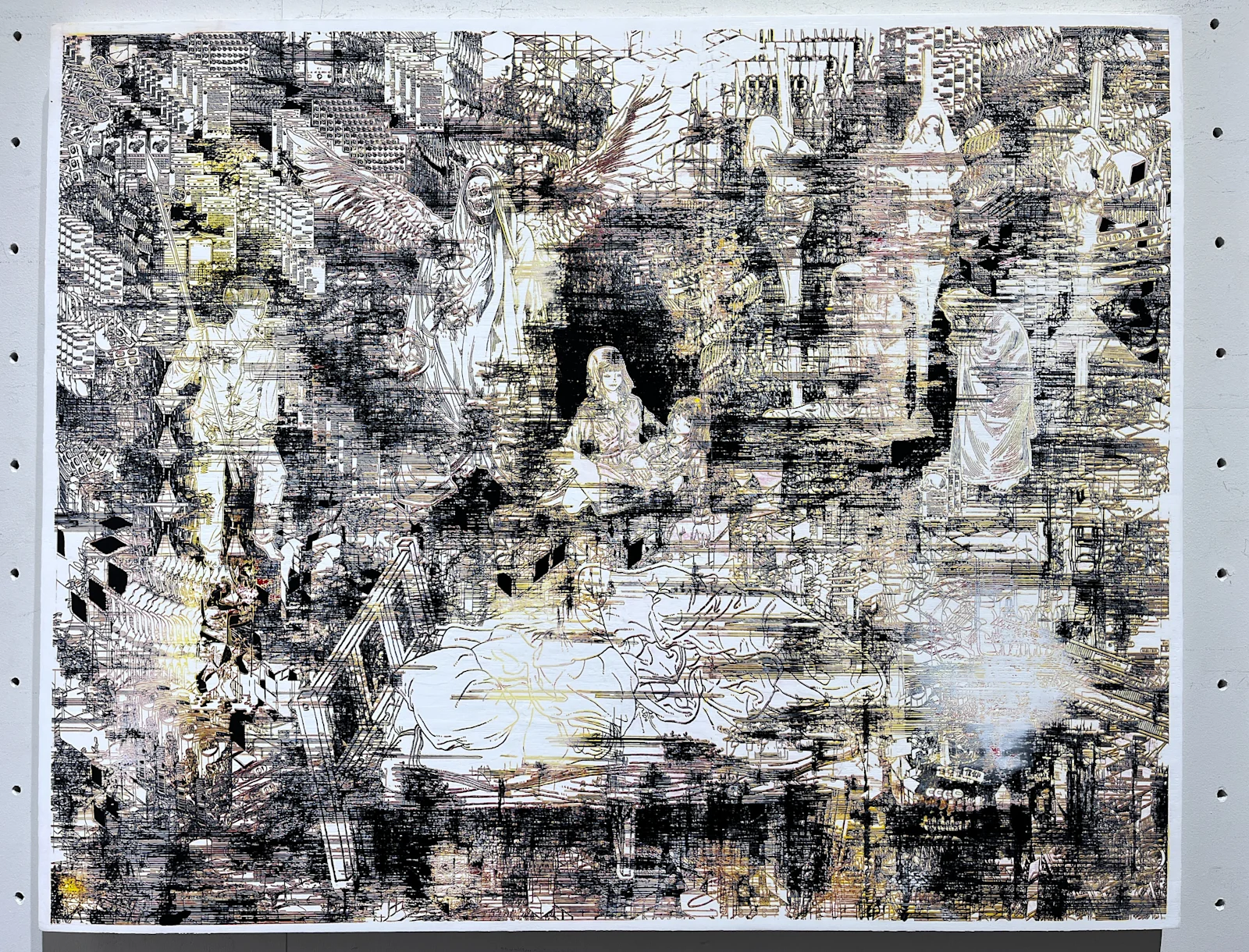
Girl Worship is a series that brings the structure of belief into the present. Of the five works, three draw on religious iconography—angels and a Madonna figure—printed in layered accumulations of color: gold and black, green and red and yellow, white and black. A fourth sets Katsushika Hokusai's The Dream of the Fisherman's Wife against a background of ten-thousand-yen banknotes. A fifth shows a girl holding a smartphone, her line of sight blocked by banknotes. Arranged under a single title, these different circuits of devotion pose the same question: why does the structure of self-offering look so similar across time?
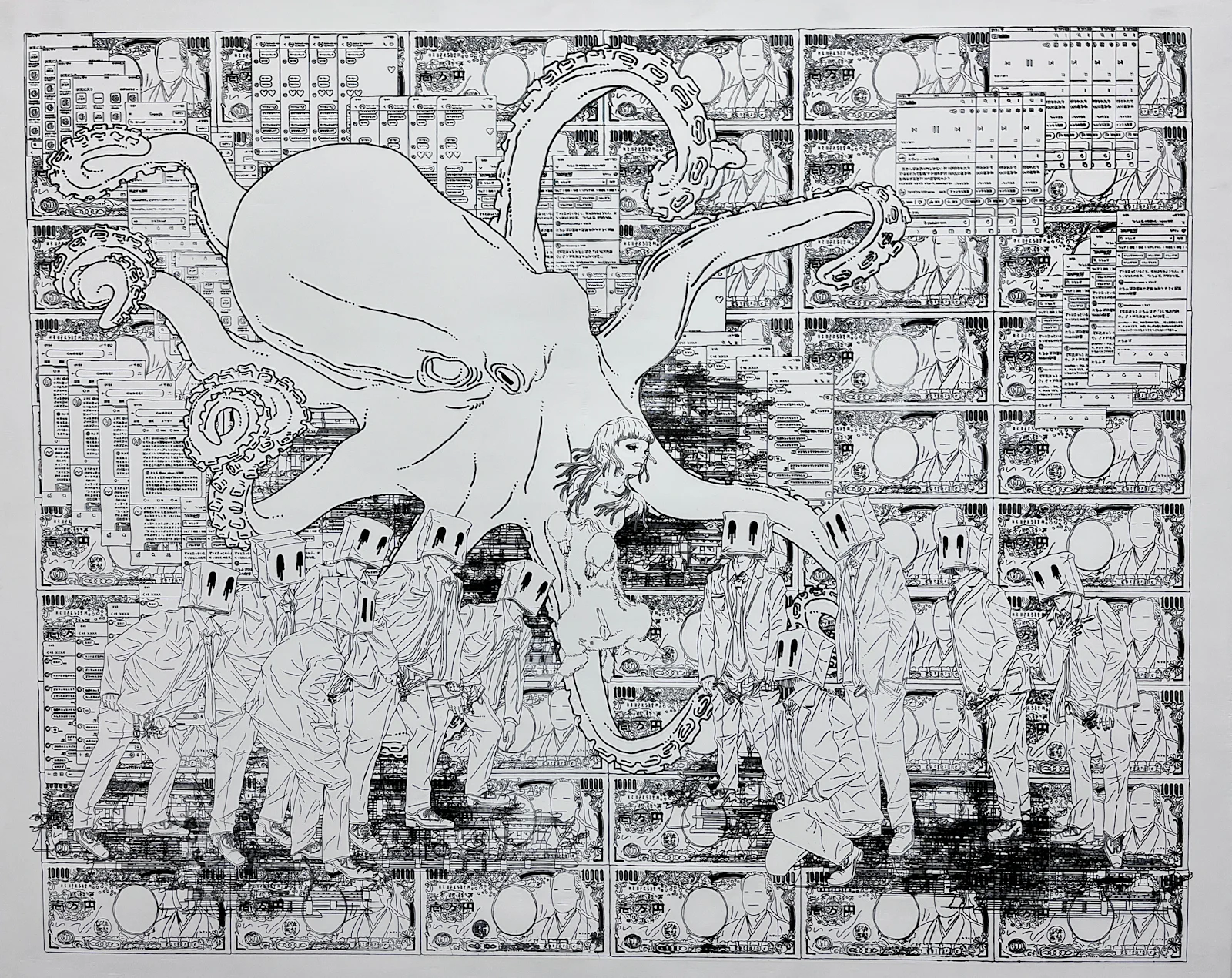
KANO encountered the phenomena of papakatsu and the Tō-yoko kids not in person but through social media. The exhibition statement makes this explicit: "I was not there. I am not one of them." No one has seen God, yet religious painting has always depicted what cannot be witnessed. KANO chooses to paint a reality accessible only through the screen.
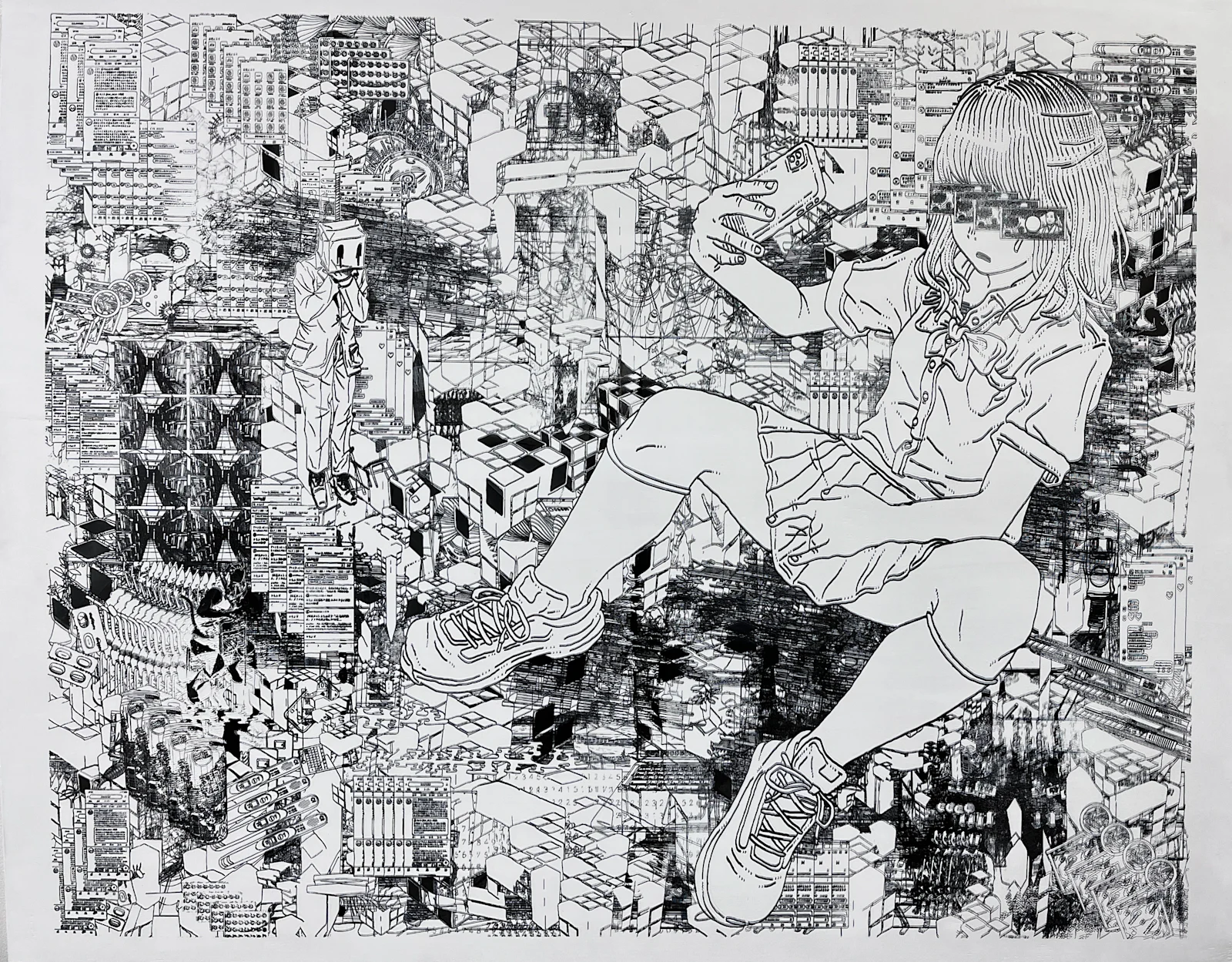
The production process is structurally continuous with this position. Acrylic ground is laid carefully on wooden panel; silkscreen is printed, painted over, sanded back, then printed again. This sequence draws on the technique of togi-makie, a lacquer process in which an image is not built up but excavated—buried beneath successive layers, then revealed through abrasion. The logic of images as they circulate on social media—replicated, displaced, dissolved—finds its correspondence in the time of making. The three religious works, each printing the same composition in a different color register, enact the same structure: a technique of reproduction that aligns with reproduction as subject matter.
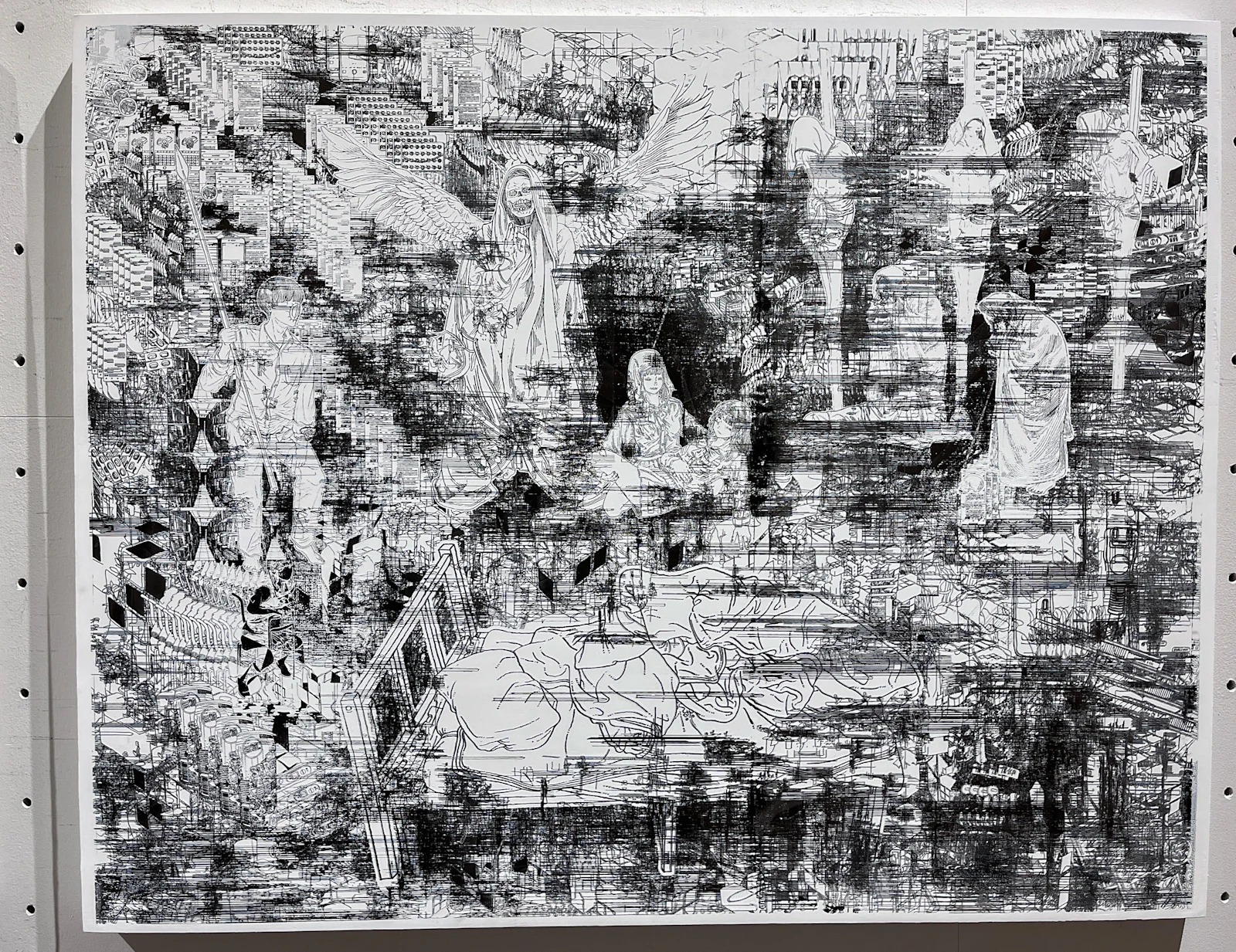
This process of repeating a reproductive technology mirrors the act of knowing the world through a smartphone screen. KANO's practice is already inside the vision that smartphones have colonized.
At the center of the three religious works stands a Madonna and child, both dressed in sailor uniforms. The girl in the position of the Madonna has her eyes and mouth sewn shut. She cannot see; she cannot speak. The girl held in the position of Christ simply has her eyes closed. The act of sewing is applied to one figure only. The one who gives, who offers herself, has her sight and voice sealed. The one who receives remains uninvolved. This asymmetry does not desecrate the iconographic tradition; it exposes the violence the tradition has always carried.
The men standing against the background of banknotes wear paper bags over their heads, oval holes cut where the eyes would be. Their faces are not erased; anonymity is actively worn. Reproduced through silkscreen, they multiply across the picture plane as pattern rather than individual. KANO himself has never set foot in Kabukichō. That distance is a confession—and simultaneously a self-insertion into the structure.
There is no exit in KANO's picture plane. The imagery of salvation breaks down inside the noise of information; the circuits of belief have their sight blocked by currency; bodies are transacted on a ground of money. To fix this stasis as image, without offering resolution. That is where the honesty of this series lies.