There is something about black that draws us in. Looking into the deep black of Haginaka Mayu's mezzotints, I find all manner of things rising up to meet me.
Mezzotint begins by working countless fine burrs into a copper plate; ink is laid into them, and plate and paper are pressed together under great force. What emerges is more than a simple transfer of image. It is a material change. The black seems to swallow the eye, yet it also holds light within it. For all its darkness, it carries a brightness, and that brightness sinks deeper into the black. The two seem to contradict each other, but as the looking continues, the gaze is drawn into the depth of the black. Even the white passages of the image carry ink. Come close and the fine black lines are still there, and still they shine. They appear whiter than the bare white of the paper itself.
Mezzotint starts with a process called graining, in which a toothed tool known as a berceau (or rocker) is rocked across the copper to lay down an even field of burrs. The white areas are then scraped back or burnished smooth so they will not hold ink, though faint grooves always remain, and the white is never truly returned to nothing. Cover the plate entirely in burrs and the result is a field of pure black; from there, the burrs are removed to coax the motif into view. Because the black is deep, the white rises; because the white is bright, the depth of the black is made visible. The two colors hold the image together, each setting off the other.
This black has a lineage. Mezzotint emerged in seventeenth-century Europe, and in French it was called la manière noire — the black manner — for its essence was in black from the start. Once used to reproduce paintings, the technique fell into disuse with the arrival of photography. It was the Yokohama-born printmaker Hasegawa Kiyoshi (1891–1980), who crossed to Paris and never returned, who re-created this nearly lost "black manner" through relentless personal inquiry, even devising an original grounding method to bring movement and rhythm into the medium. Today, in Japan, mezzotint is so rarely chosen that perhaps one or two students attempt it across an entire graduating class. To choose it at all is already unusual; the cost of mastering it is high, and the teachers who can guide it are few.
I first encountered Haginaka's work at the undergraduate graduation exhibition. A screen of arresting black gradations, populated by character-like motifs; there was a story in it, and the gradations of that black-and-white world seemed to carry me somewhere far away.
Entering graduate school, Haginaka pushed deeper into the technique itself. At the first-year review, the pursuit was already toward a particular ideal black, arrived at by varying everything: the manufacture date of the berceau, its gauge, whether the blade was new or worn dull, the number of times the plate was grained. The same motif had been tried dozens of times over, with the parameters shifted each time: the gauge of the tool, the count and direction of the graining. The pressure of the body behind the rocker, the state of the blade's wear, all of it bears on the final image. Everything was in service of meeting the black being sought.
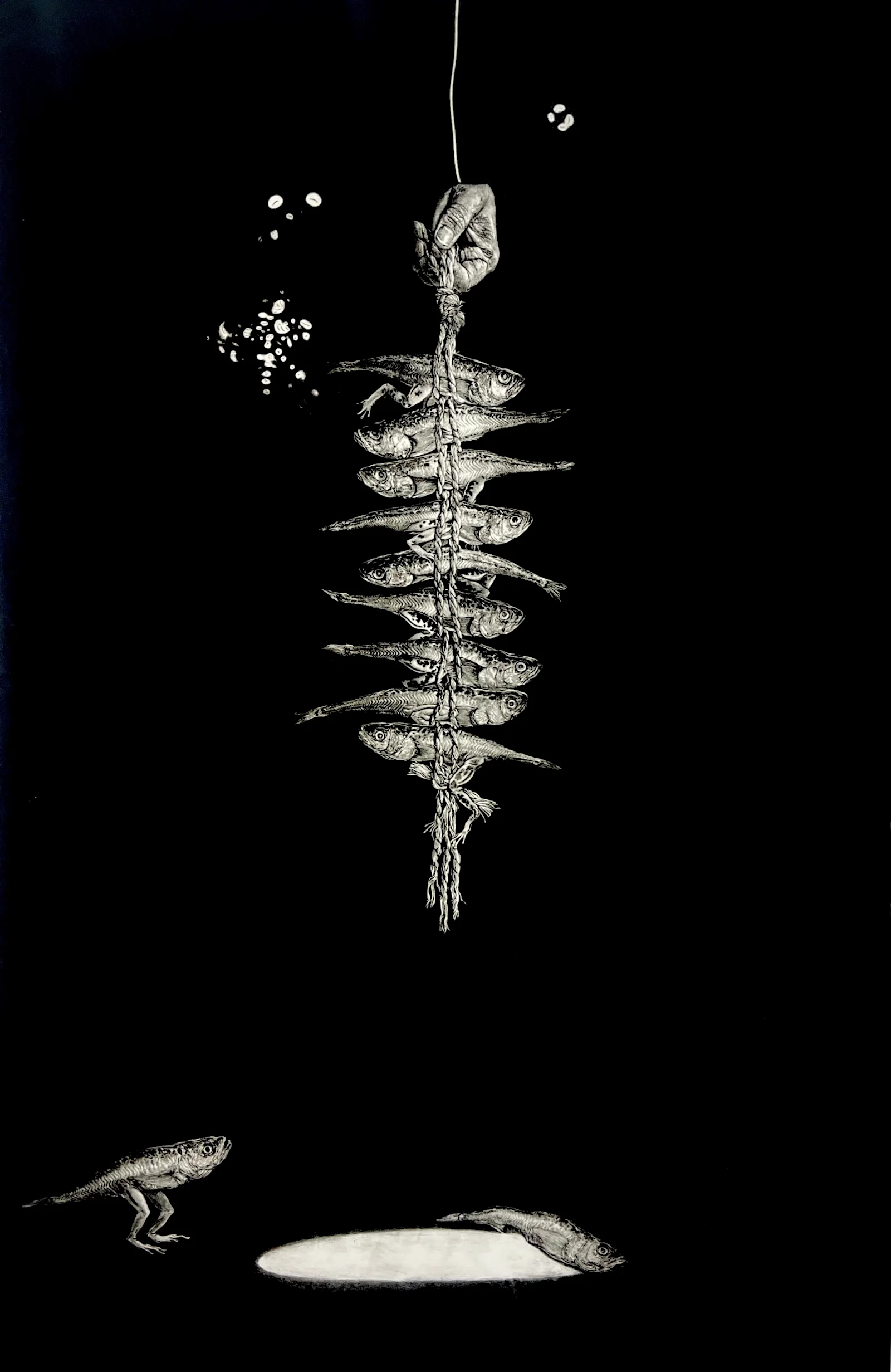
Himono Escape (干物脱走) is a large mezzotint, 142 × 92 cm, oriented vertically, its surface given over almost entirely to black. From the top of the image a hand enters, holding a cord to which more than a dozen small fish are bound. Himono — fish sun-dried to preserve a surplus catch, a food long familiar to the Japanese table. At the bottom the cord has come loose: a fish that has grown legs stands upright, looking back up at the comrades still tied to the line, as if, just freed, it were taking stock of the situation it had been in. Another has slipped the cord but lies there limp. Look closely and the fish still bound to the line have grown legs as well, and each is rendered as its own creature, distinct in the texture of its scales, the cast of its eye, the twist of its body. These are not anonymous foodstuffs lumped together, but individuals, each with a life of its own. Near the lower edge, within the lustrous black, a stage-like pool of spotlight falls, as if a curtain were rising on a story about to begin.
That deep, sinking black against the bright white of the spotlight makes a vivid contrast; it is precisely because the black sinks so far that the burnished white can shine. But this work of black is no mere display of skill. Fish dried and strung on a line; one trying to flee. To escape being eaten, even after being made into himono, already processed, already finished as food. This subject, absurd and yet faintly comic, is held in suspension by the black of the mezzotint. The gravity of the black lifts the small escape drama to the threshold of life and death, lending it the weight of a fundamental refusal to be consumed. And that every fish is drawn as its own creature is itself a quiet thesis: a refusal of the anonymity that lumps lives together as foodstuff, a refusal of othering. By giving each bound individual a face of its own, Haginaka restores singular life to what would otherwise be massed into a faceless group. The black once called la manière noire here comes to hold a question of existence itself.
And this black was chosen at the end of six years of inquiry. The long research process, the search for an ideal black, is folded into the very intensity of the image. For Haginaka Mayu, the process of arriving at black is not the acquisition of technique but the core of expression itself. Six years led, at last, to this black.
Hasegawa was no teacher to Haginaka in the ordinary sense. Yet a Hasegawa print came into Haginaka's hands, and in it was the ideal black, and with it the knowledge of the gauge and the number of grainings that such a black required. The kinship is unmistakable: a shared spirit of inquiry. Haginaka belongs to the order of those who search. The black remains ahead.