Chiasme
ISHIGURO Hikaru, ISHIMATSU Yufu, MATSUDA Nayuko, Tazaki Ari
aaploit presents Chiasme, a group exhibition of four artists—Ishiguro Hikaru, Ishimatsu Yufu, Tazaki Ari, and Matsuda Nayuko—on view from July 4 through July 27, 2025.
Chiasme is a concept employed by the philosopher Maurice Merleau-Ponty to describe the intertwining of perceiver and perceived. When the right hand touches the left, the one that touches and the one that is touched exist simultaneously—a structure in which the distinction between subject and object becomes unstable. The same applies to vision: when we look at a landscape, its color and light do not merely register on the eye but stir emotion and memory, producing a resonance within.¹
This exhibition brings together four young artists from the perspective of the chiasmus. In the experience of viewing painting, a unidirectional relationship is typically assumed: the viewer (subject) looks at the painting (object). Yet through the act of seeing, the world of the painting connects to something inside the viewer, and new interpretations and emotions emerge—a reciprocal artistic experience.
Ishiguro Hikaru's practice extracts the concept of the interface from Marcel Duchamp's "inframince," developing her own interpretation. Her exploration of the zone where the resonance dwelling in matter and the spirit that perceives it intersect originates in this attention to the interface. The butterflies, moths, and shells that recur in Ishiguro's work transcend the boundaries of material existence, symbolizing the fragility and circulation of life. The floating female faces that appear within the picture plane—rendered as "precious children"—carry expressions that could belong to a girl or an adult, positioning them as presences that probe the boundary between reality and the deeper layers of consciousness. This crossing of gazes between viewer and work reopens the question of seeing and being seen, inviting an inner dialogue. Ishiguro's process of making functions as what Freud called "the work of mourning": beginning from personal loss, the expression is sublimated into a domain of emotion that can be shared. The traces of introspection and resistance that emerge through dialogue with the self via the sign of "the person" carry the reach to question the very nature of subjectivity in our time.
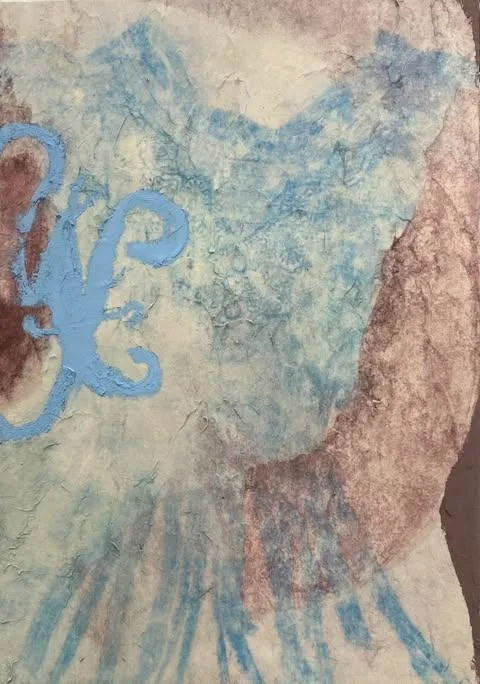
ISHIGURO Hikaru, Sleep with one body, 2025, Gassan washi paper, glue, water-based ink, mineral pigments (Suihi-enogu), oil pastel, 227 × 158 mm, ©2025 ISHIGURO Hikaru, Courtesy of the Artist and aaploit
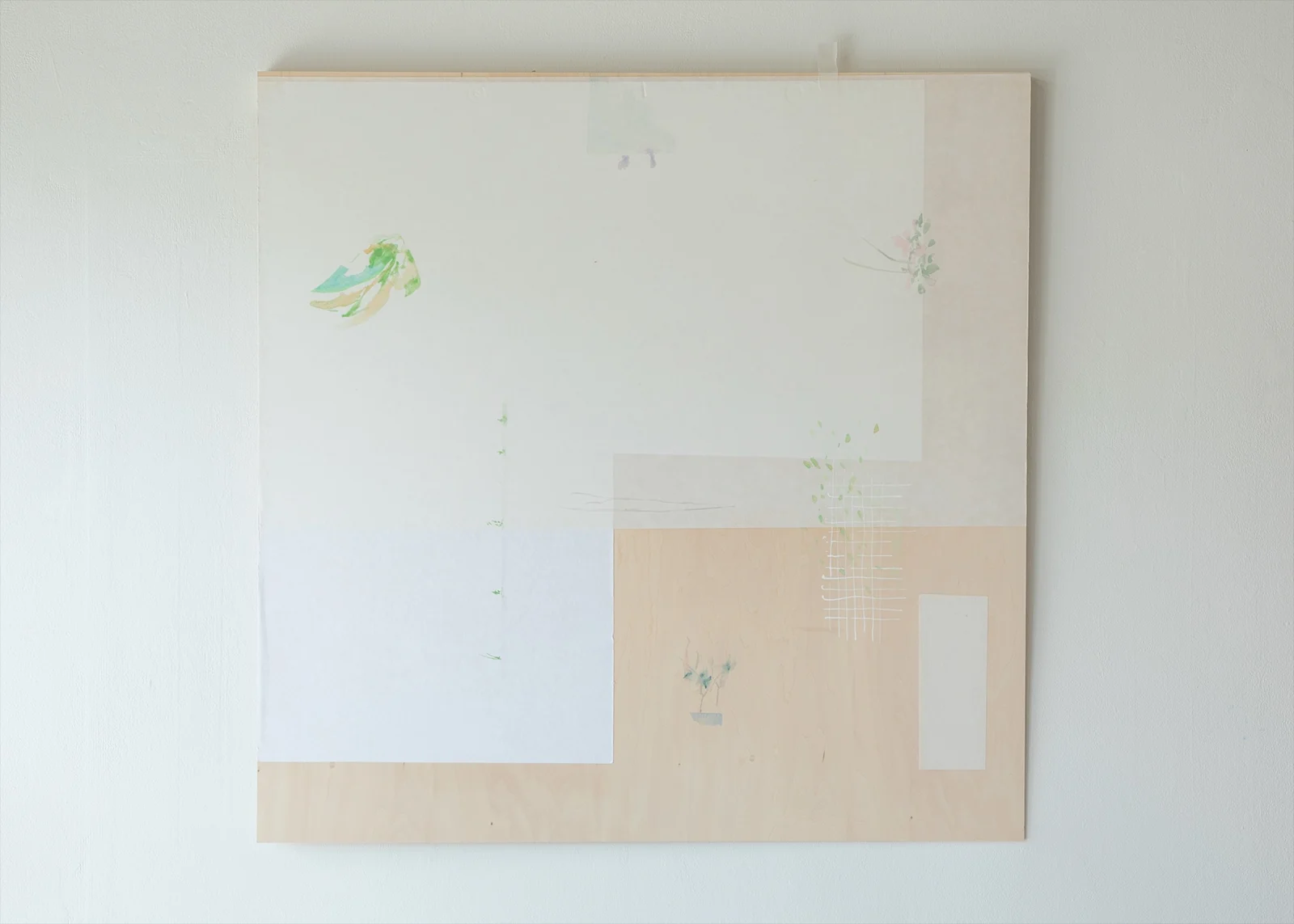
Ishimatsu Yufu paints from the memory of landscapes she has seen, using Japanese painting materials. By introducing a gap between the time of seeing and the time of painting, the depicted image becomes somewhat more abstract than the landscape actually witnessed. Within this temporal interval, memory takes on ambiguity and begins to overlap with painting's inherent capacity for abstraction. A Vessel Filling a Cup, Breathing Within (2025) unfolds this relationship between memory and painting within a spatial dimension. Installed on a staircase landing, the work responds to the sway of the viewer's body while ascending, spatially staging the experience of a "vessel" suggested by the title. By deliberately foregrounding the wooden panel support, what is normally concealed as painting's structure functions as a visual element equal to the floral motifs painted on Japanese paper; the two float in space, complementing each other. The intentional warping of the board physically expresses the instability of memory as it changes over time, presenting the temporal distance between seeing and painting as an expression integrated with space. Fusuma paintings, folding screens, hanging scrolls in the tokonoma—Japanese art has historically been closely tied to living space. As ways of life change, Ishimatsu's practice attempts to reconnect art with the memory of daily life, bringing a new intimacy to contemporary living spaces. While using the vocabulary of traditional Japanese painting, her challenging methods—foregrounding the support, integrating with space—expand the possibilities of painting itself.
Tazaki Ari explores the relationship between contemporary society and the natural environment through a distinctive pictorial language that dissolves the boundary between observer and observed. Her experience working in wildlife conservation has resulted in a perspective that depicts the mutually interpenetrating relationship between humans and nature. Endless Circle demonstrates the core of Tazaki's painting practice. The goggle-shaped frame covering the entire picture plane guides the viewer's gaze into the work's interior, gradually reversing the observing subject into the observed object. The hunting eagle depicted underwater and the human ring evoking the children's game kagome kagome seem to make visible a world structure in which the workings of nature and human activity are inseparably intertwined. This entanglement reveals a nested structure of subject and object, and through that structure, Tazaki's painting re-examines the very act of viewing. Viewers will experience becoming part of a complexly entangled world, simultaneously the one who sees and the one who is seen.
Matsuda Nayuko creates pictorial spaces in which boundaries dissolve, combining acrylic, watercolor, and mineral pigments. The layering of materials with different properties captures the organic growth and change of the natural world while producing a field where solid form and fluid space coexist. In Yuri-shiro-iro no, pink and purple faintly emerge within a surface dominated by blues and greens. Bold areas of blank space and deliberately placed openings create room where the material presence of the painting and the viewer's perception can meet. The bleeding technique, in which colors permeate one another, blurs the boundaries between elements and seems to lodge the passage of time within a quiet space. Through the polysemy of language and visual ambiguity, Matsuda's painting resonates with each viewer's own memories and emotions. It is not a mere reproduction of landscape but a process in which new meaning is continuously generated within the act of viewing—gently calling forth the viewer's inner narrative while oscillating between seeing and being seen.
Each of the four young artists embodies this chiasmus of seeing and being seen through their own distinct expression. Through works that respond to the viewer's movement and gaze, surfaces that change expression with the passage of time, and experiments with brushwork and matière that resonate with bodily sensation, the exhibition offers not simply an experience of "looking at" works, but of deeply "encountering" them—discovering something new through active engagement.
¹ Maurice Merleau-Ponty. The Visible and the Invisible. Trans. Takiura Shizuo, Kida Gen. Misuzu Shobo. 2017 new edition. pp. 184–186.
For inquiries regarding the exhibition, please contact info@aaploit.com.
Chiasme
- Dates
- July 4 – July 27, 2025
- Hours
- Friday, Saturday, Sunday 13:00–18:00 Viewings by appointment available on other days
- Venue
- aaploit, Tokyo
Artists
ISHIGURO Hikaru
b. 2002
Positions painting at the interface arising between the material and spiritual realms. Retrieves the contours of unspoken dissonance, tremors, and presences stripped of substance.
Selected exhibitions include witch craft (solo, haco-art brewing gallery-, Tokyo, 2024) and Chiasmus (group, aaploit, Tokyo, 2025). Awards include the Excellence Award, 44th International Takifuji Art Award (2023) and the Special Prize, 9th Ishimoto Sho Nihonga Grand Prize Exhibition (2024).
Born 2002 in Yamagata, Japan. Tohoku University of Art and Design, BFA and MFA in Japanese Painting.
ISHIMATSU Yufu
b. 1999
Ishimatsu Yufu paints plant motifs in mineral pigments, gofun, and sumi ink on Japanese paper mounted on Shina plywood. The image surfaces on both the wooden ground and the paper, drifting between layers. Loosening the transparency that Japanese painting has long granted its support, the picture plane sways with light and with the viewer's movement through space. Born 1999 in Oita Prefecture; MFA in Japanese Painting, Saga University Graduate School of Regional Design (2025).
MATSUDA Nayuko
b. 2002
MATSUDA Nayuko is a painter who works in stain technique. Controlling the process by which color soaks into raw canvas, she partitions the surface into areas the pigment reaches and areas it does not, treating the border between image and ground with the same intensity as the relations between motifs within the painting itself. Plants, figures, and landscape coexist on the surface, each remaining slightly distinct, and the gaze moves between elements, assembling its own reading.
Born in Aichi Prefecture in 2002. Graduated from the Department of Painting, Oil Painting Course, Musashino Art University, in 2025; currently enrolled in the same university's graduate school. Selected exhibitions include FACE 2024 (Sompo Museum of Art, Tokyo), Inter-University Five Art Schools Exchange Exhibition (Tokyo, 2024), Spring Footsteps II (Suzu Gallery, Tokyo, 2024), and For Want of a Single Needle (gallery33 south, Tokyo, 2023). Recipient of the Special Recommendation Prize at the Inter-University Five Art Schools Exchange Exhibition, Tokyo (2024), and the Encouragement Prize at the 49th Tokyo Exhibition of Art (2023).