On “Storytelling”
Storytelling October 16 – November 1, 2026 aaploit, Tokyo
Asano Miyabi, Kato Megumi, Suzuki Nina, masuda aoi, Morisakorisa
Storytelling is the act of telling a story to someone. It is one form of communication between a teller and a listener. The teller shapes the story to the listener’s interests: a traveler recounting what they saw abroad, a parent reading a picture book aloud. The listener, for their part, has always come prepared. Before settling in to listen, they knew who was speaking, and had some sense of how to take what they were about to hear.
Today, companies speak of their purpose, and products arrive with origin stories. In the course of a single day, we are handed more stories than we can count. Storytelling in this sense is a technique: a way of drawing out the listener’s empathy and guiding them toward action. Every such story has a teller, and every teller has an intention.
Yet when stories saturate everyday life to this degree, listening no longer registers as something we do. We have grown too used to being handed stories.
This exhibition has no narrator. The five artists work with newspaper reports, bound books, fragments of ruins, memory held in the body, and single scenes that seem lifted from a larger tale. Each of these forms appears to be telling us something, yet none reveals who is speaking, or why.
These works were not gathered as a critique of marketing. What brings them together is a shared reticence. Each takes up a form that usually comes with a voice attached, and leaves the voice out.
And still, standing before the works, we begin to read.
Asano Miyabi produces a newspaper that reports an incident that never happened, alongside a manga said to have been inspired by it. Faced with the paper, we follow the article as though the event were real, and we look for the thread that connects the report to the comic. Each piece wears the face of something that refers to another. Nowhere are we told that the starting point is fiction.
masuda aoi draws images that resemble illustrations without a text. Bound into book form, they prompt us to read in order, and as we turn the pages we find ourselves supplying the plot that would link one image to the next. Where the story ends is left to us.
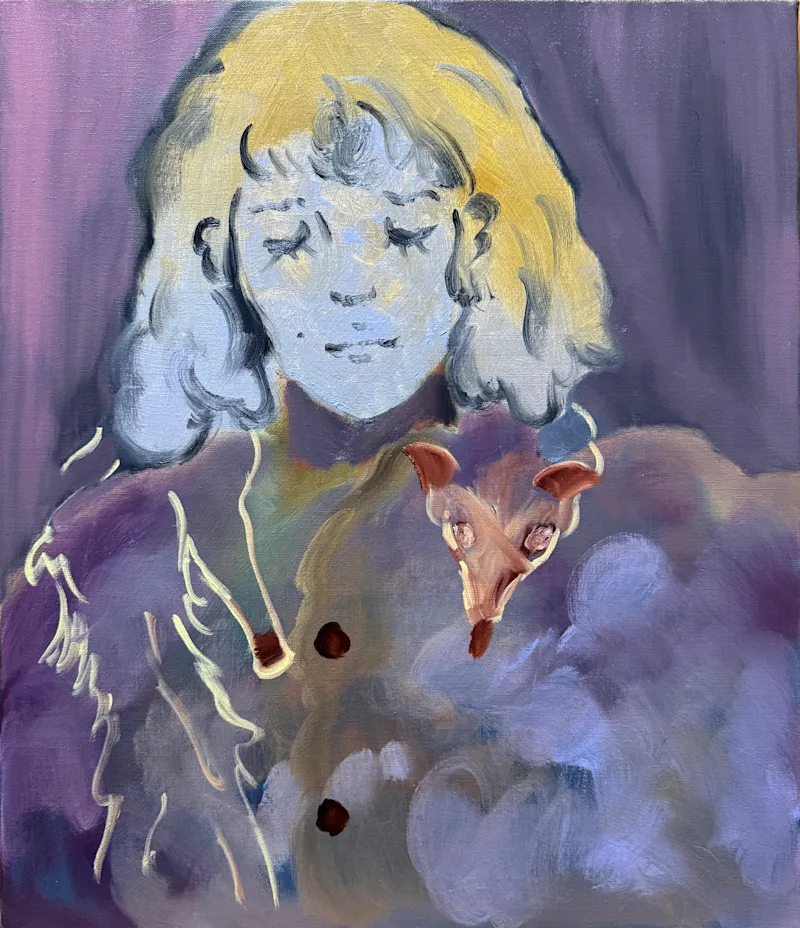
Morisakorisa paints scenes that call a story to mind, yet show only what is there. A woman holds her eyes closed against a purple ground, and we wonder whether the color is her state of mind. The stole around her shoulders looks like fur, yet seems to be alive. Is this a still from an old film, or a world imagined? The painting does not say why we are being shown it. We imagine what led up to the moment, and what comes after.
Suzuki Nina’s paintings feature figures that are almost human, but not quite. Whether they come before humanity or lie somewhere beyond it, the paintings do not say. One viewer sees an ancestor, another a descendant. We choose even the direction of time ourselves, and read on.
Kato Megumi works in fresco, a technique said to hold an image intact for a thousand years. What she paints, however, may itself be forgotten within a few years. Her subject here is a pop idol serving as an honorary “one-day police chief,” a familiar publicity custom in Japan in which a celebrity is appointed head of a police station for a day to promote a public safety campaign. An image produced for public relations is rendered in a medium meant to last a millennium. Presented as a fragment, it loses any trace of who was speaking, and to what end. Even so, we search it, as we would an excavated relic, for the lost whole and its history.
A story arises even without a narrator. It is not the works that are speaking. We are the ones reading. What this exhibition offers is not a story as such, but our reflex to read one, a reflex we cannot seem to switch off.
This reflex has been cultivated by the storytelling that surrounds us. Eyes accustomed to receiving a teller’s intentions will, even when no teller is present, supply an intention and keep reading. If so, being on guard against storytelling is not only a matter of doubting the teller. It begins with noticing our own habit of wanting a story.
Saito Tsutomu, Director, aaploit