A long time has passed since information and images began to circulate without passing through physical media. For some of us, daily life now means reading from a display far more often than from a printed page.
Printmaking developed as a technique for transferring an image onto multiple supports and putting it into wide circulation. In Japan the woodblock proved an effective means, and ukiyo-e from the middle of the Edo period onward reached a broad popular audience. As a reproductive technology, printmaking was organized along something like industrial lines: one person drew the design, another cut the block, another pulled the impression. This division of labor allowed prints to be produced and distributed in large numbers. From the late Meiji into the Taishō era, however, a movement arose that emphasized the creative dimension of the medium and sought to establish it as an independent category of art: the sōsaku-hanga, or creative print, movement. The printmaker Yamamoto Kanae raised the banner of jiga, jikoku, jizuri, drawn, carved and printed by one's own hand, and printmaking came to be understood no longer as a technique organized by division of labor but as an art centered on individual creativity.
Jiga, jikoku, jizuri meant that a single person would take on every stage of a process that had until then been divided among specialists and so recover its creativeauthorship. This may seem self-evident for a print regarded as a work of art, but it is with this movement that modern printmaking in Japan begins.
When we hear the word "print," the most familiar image is probably the woodcut: a wooden block cut with a chisel, ink adhering to the flat surface while the carved areas come out white. Munakata Shikō, drawing on the nebuta paintings of his native Aomori, brushed his images onto the block in sumi ink and carved them, leaving works of great force.
Prints of this kind are relief prints: ink is applied to the raised areas of the block, and the block is pressed against the paper to transfer the image. Other categories include intaglio, where ink held in incised grooves is lifted onto the paper; planographic printing, where the repulsion of water and oil keeps ink in particular areas; and stencil printing, in which openings corresponding to the desired image are made in a fabric-like screen so that ink passes through, yielding an image that is not reversed. The images that emerge look quite different from one another, yet all of these are printmaking techniques. Stencil printing is also the principle behind the digital duplicators still seen in offices today, and it was used for commercial printing before inkjet came into wide use.
Andy Warhol, who had made a successful career as a commercial designer and illustrator, turned to art in 1960. In works such as the Campbell's soup cans and the portraits of Marilyn Monroe, he took images already in circulation and consumption and, through silkscreen, repeated and re-produced them. Pop art, of which Warhol's work is emblematic, emerged from a society of mass production and mass consumption. Within it, printmaking expanded beyond a field for deepening expression and pursuing technique to become also a means of pursuing a concept.
Printmaking was thus born as a reproductive technology; many artists then tested it as a field of expression; and it diversified further into a means of articulating particular concepts. Now that the reproduction and circulation of information and images overflow across displays without the physical processes of printing or printmaking, what place might we grant to the act of making a plate and pulling an impression, and to the art that comes of it?
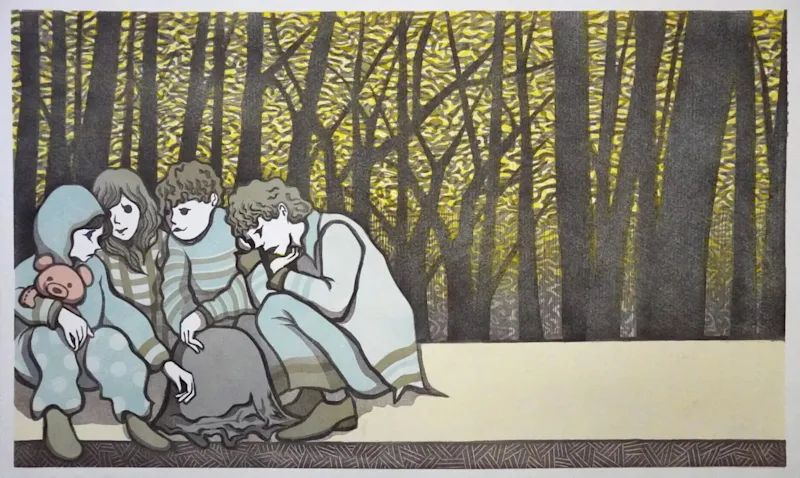
Michimata Aoi, who is also to exhibit at aaploit, has made the series Kafka's Staircase, prints inspired by the concept of that name proposed by the social activist Ikuta Takeshi. Staircases and a range of figures appear on the picture plane, and the woodcut treatment yields a surface with warmth and a sense of narrative.
As for technique, Michimata carves the block to a certain point and prints, then carves further and prints again: the reduction method, in which a single block yields several colors. Printmaking is generally supposed to be a means of producing the same image over and over, yet in Michimata's work no more can be made than the number pulled at the outset, and once the final printing is done the block can never yield that work again. The very property that defines the medium, the multiplicity that having a plate makes possible, is in the end relinquished.
With works like these putting the "reproductive technology" side of printmaking into perspective, let us return to carving and printing and consider this ground again.
Printing, in the making of a print, is not necessarily the final stage in arriving at a finished work. While the plate is still being made, one surely pulls a proof to check how it is coming out. Unlike painting, where one works directly on the support, printmaking places between the drawing and its result a stage, printing, that carries an element of chance. Does one draw with a fixed aim toward that stage, or deliberately accumulate accidents? In this possibility of choosing, too, we may see one aspect of printmaking.
Carving and printing repeat the translation of an image. That the act repeats while the image does not necessarily repeat: this property of the making process may be where thinking about printmaking today begins.
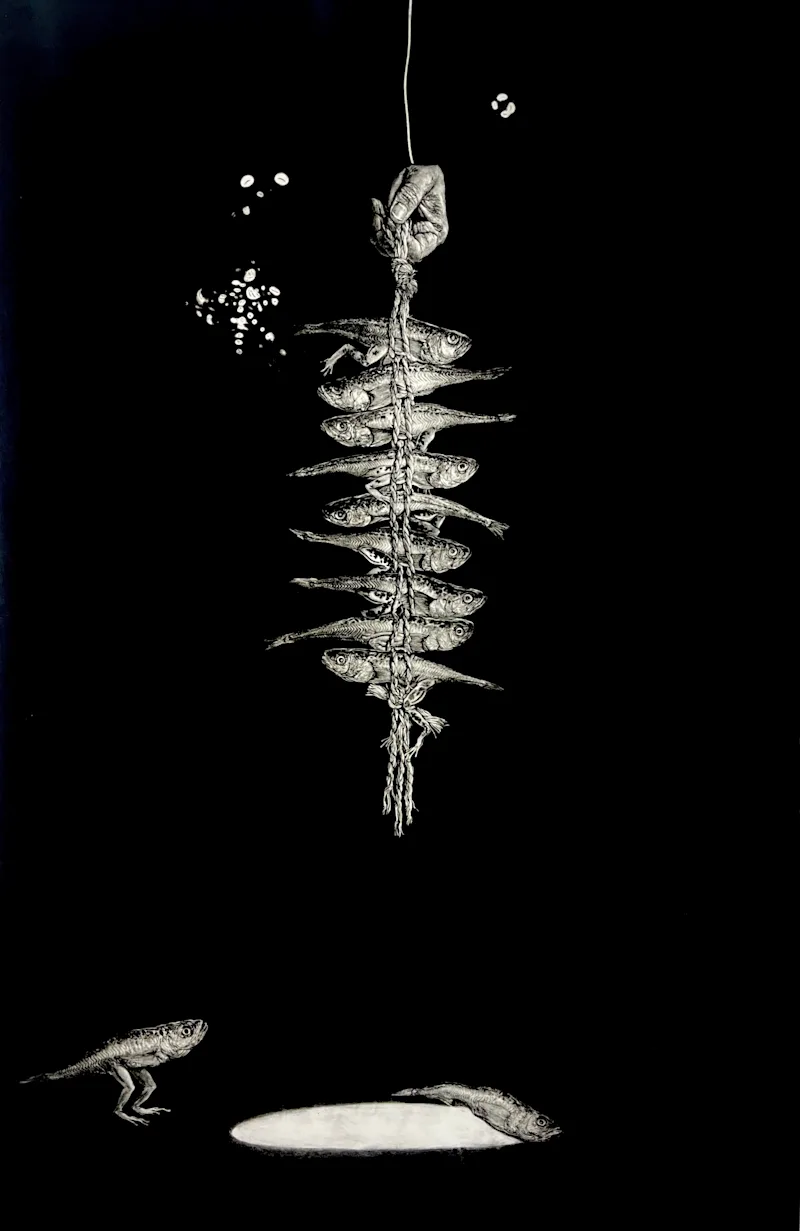
Now that it has become difficult to assign the category of printmaking to the images that appear before us, it is striking that an exhibition of artists who use printmaking as a means of expression should be titled ITERATION. This exhibition should serve as an occasion for grasping printmaking not merely as a classification within a field of expression, but through the act itself.
As for the works, I will leave them here, as something to think through after seeing the exhibition.
Curator Takeda Ayari