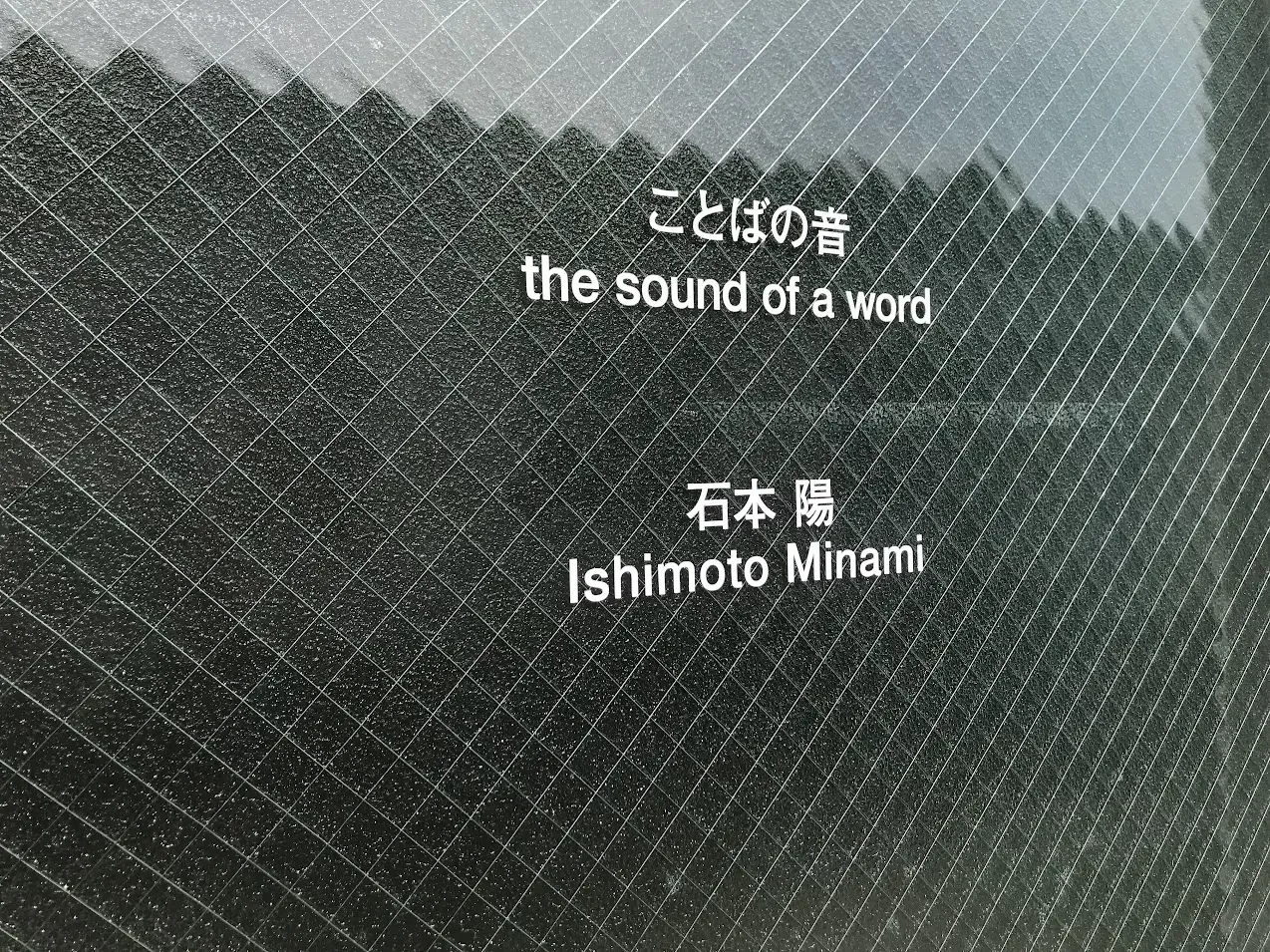
The Sound of Words
ISHIMOTO Minami
aaploit presents The Sound of Words, a solo exhibition by Ishimoto Minami, on view from August 19 through September 4, 2022. This is Ishimoto's first exhibition following the completion of his graduate studies at Saga University. The exhibition is co-organized with PHOTO GALLERY FLOW NAGOYA.
Ishimoto has produced work exploring the relationship between sound, language, and vision. What is the origin of language? When a person speaks, the way words resonate as sound holds an inseparable relationship with meaning. When that meaning is deconstructed, how do "words" sound? What do we feel when we hear them? Sound is something to be listened to—questioning this assumption, Ishimoto has consistently created work that interrogates our relationship with sound.
Visible Sound (2020) was an installation performance in which environmental sounds were picked up by microphone, visualized as waveforms on a display, and a performer—hearing blocked by headphones—pulled roll paper from the ceiling and transcribed the ceaselessly flowing waveforms in pencil. The paper accumulating in the room created new environmental sounds that fed back into the work. This piece, probing the space between hearing and seeing, used the piling paper to suggest the passage of time, while the roll descending from the ceiling implied an apparently perpetual loop.
In The Sound of Words (2022), sound is apprehended as language. The work, expressed in multiple layers of paper and tracing paper, contains sequences of hiragana that are partly unintelligible. At first glance, they do not function as words. Paired with a recitation, the sounds heard begin to be grasped as language, evoking a narrative. Yet the recited voice, too, has its words displaced in places. When sound is recognized as language, even if the actual sound is slightly shifted, the transfer from sound to word has already occurred, and the original sound can no longer be fully grasped. Ishimoto's work seems to capture this transition from sensation to thought.
Misspeaking, mishearing—when knowledge was transmitted orally, such errors must have occurred. When sound became language and was given written form, it began to function as archive. Something must inevitably have been lost. The Kojiki, for instance, is thought to have been transmitted orally¹—but what intonation was used? It has been suggested that it may have resembled shigin, a form of chanted poetry. Where and how were accents placed? Sound and language. The relationship between meaning bound to sound by accident has likely been reinforced over time.
This exhibition was also presented at PHOTO GALLERY FLOW NAGOYA. What did it mean for Ishimoto's work to be shown in a photography gallery? Tony Godfrey wrote: "The greatest benefit that Conceptual Art produced through the use of photography was not to state the self-evident, but to give photography the function of posing questions."²
Artist Statement
By putting into "words" the feelings we ordinarily sense without thinking, we can become aware of what we were thinking, and this can direct our thoughts and actions. Even without telling anyone—simply writing it down for ourselves—the effect is sufficient. But when "words" are spoken to someone else, through the act of listening, those words come to exist not in one's private world but in society, and in the sense that they can no longer be unsaid or unheard, they become real.
Beyond seeking infinite meaning within sound, might there not be a force within "words" that works to become an expanse and a field into which one invests one's life and being, precisely in order to seek that infinite meaning?
This solo exhibition explores the relationship between sound and space, taking Japanese "words" as its subject. The exhibition presents The Sound of Words, originally shown at Saga University, as scenography. When an installation is recorded as photography and presented, does it function as an exhibition archive, or does it become a different work through the medium of photography? Please observe how this connects with and accumulates upon the act of exchanging "words" described above.
¹ Miura Yūsuke. Kojiki: Colloquial Translation, Age of the Gods. Bunshun Bunko, 2006.
² Tony Godfrey. Conceptual Art. Trans. Kohata Kazue. Iwanami Shoten, 2001.
For inquiries regarding the exhibition and works, please contact info@aaploit.com.
The Sound of Words
- Dates
- August 19 – September 4, 2022
- Hours
- Friday, Saturday, Sunday 13:00–18:00 Viewings by appointment available on other days
- Venue
- aaploit, Tokyo
Artist
ISHIMOTO Minami
Originally from Fukuoka Prefecture, I graduated from the Graduate School of Regional Design at Saga University in 2022. I have been creating sound-based works since my undergraduate days and have actively exhibited my work both on and off campus.