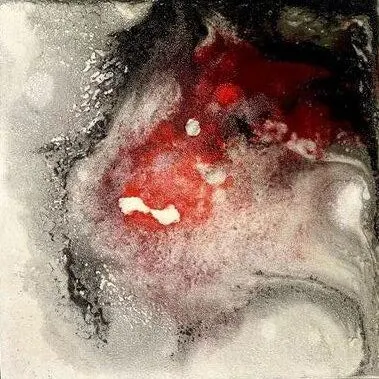
Sumi ink, animal glue, and gofun, the constituent elements of painting, are respectively carbon, protein, and calcium, the same elements that constitute living organisms. While painting materials feel continuous with the painter's own body, the act of making also carries the sense of bringing forth an artificial organism. Just as stretched washi comes to look lustrous, these materials are met with an urgent sympathy. What the painting seeks to bring into view is a vast landscape not yet seen, and that landscape is the very condition of the human being: taking in others, altering in its details, and still holding its shape as a whole.
Matsushita chews back through the materials, techniques, and thought that begin in the field of Nihonga, taking them on through her own body. Through this practice she reassembles art with her own hands. What lies further out, in the deviation from that ground, is the uncharted territory she is after.
In recent years she has received the raw hides of deer and boar taken in hunting and produced animal glue by kawazuke, the traditional method in which the hides are broken down by bacteria in a river. This is in order to recognize glue, the binding medium of Nihonga, not merely as a painting material but as a presence that holds the history of land and life.